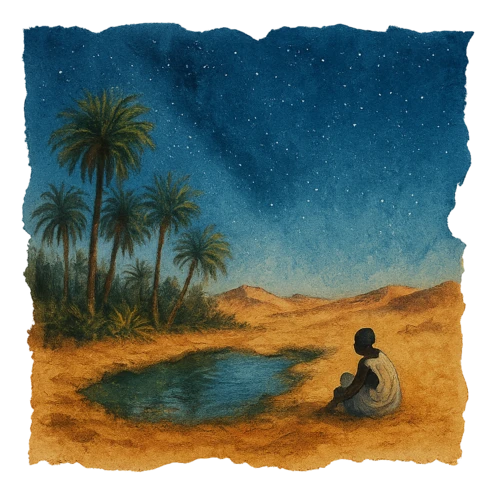
Chapter Twenty: The Oasis
The first thing Elias felt was silence. Not the gentle stillness of night in the Sanctuary, but something more profound. He opened his eyes to a sky so vast it swallowed everything—an ocean of stars spilling across the heavens in glittering, impossible clarity.
He was standing on the crest of a sand dune. Golden grains shifted beneath his bare feet, radiating a deep, inherent warmth. The wind brushed past him in long, cooling currents—carrying the scent of dust, dry earth, and something faintly sweet, like dates left to ripen in the heat.
Elias exhaled slowly. It was a dream. He knew it the way one knows a forgotten childhood memory—intuitively, bone-deep. And yet everything felt solid. Real. The desert air chilled his skin. The sand gently collapsed around his toes. The sky above seemed close enough that he could reach up and disturb the constellations with his hand.
Down the slope of the dune, an oasis shimmered in the dark. Palm trees ringed a small, clear pool that reflected the stars like a bowl of ink scattered with silver. A slow trickle of water fed it from a spring hidden beneath the sand. And beside the pool burned a fire—steady, warm, its orange glow licking gently at the night.
A man sat beside it. A lone silhouette in the fire’s glow, shape indistinct at this distance. There was something familiar about the posture, the calm stillness.
Elias started descending the dune. The sand slid beneath his steps, warm at first, then cool where the night had begun to claim it. Each footfall sank with a soft sigh, leaving impressions that the wind eagerly swallowed.
The warmth of the oasis fire brushed against the cold night, like hands reaching out in welcome. Elias closed the distance, step by step, until the man’s features began to sharpen in the glow.
Dark skin. Strong shoulders. Hair shorn close to the head. Bare feet resting lightly on the sand. His eyes reflected the fire like two wells of deep water.
Elias froze. He knew that face. It was the prisoner from the West Tunnels, unmistakably him, but decades younger.
The man looked up, calm and expecting. As if meeting Elias in the desert night was the most natural thing in the world. He raised a hand and gestured to the empty space beside him. “Come,” he said, his voice low and steady. “The fire is friendlier than the night.”
Elias hesitated only a moment before stepping into the circle of warmth. The sand near the fire was pleasantly heated, and when he sat, a wave of comfort rolled through his limbs. Sparks drifted upward into the sky, swallowed by the endless stars.
They sat in silence for a few breaths. The man watched the flames. Elias watched the man. Finally, Elias found his voice. “I didn’t expect to see you here,” he murmured.
The man’s lips curved faintly. “Dreams take us where we need to go, not where we expect.”
Elias frowned. “So this is your doing?”
“Not entirely,” the man said. “Dreams are… conversations. The dreamer shapes them. The dream shapes back.”
He turned his head then, meeting Elias’s eyes with a gaze that felt impossibly deep.
“You should ask,” the man said. “I can see the questions rattling in your bones.”
Elias swallowed. “Who are you?”
The man chuckled softly, not mocking—more like someone amused by a child’s earnestness.
“That,” he said gently, “is the wrong question.”
He reached out, tapping two fingers lightly against Elias’s chest.
“The question you should be asking is — who are you?”
Elias didn’t know what to say. He couldn’t find the right words. The question didn’t feel philosophical. It felt like an accusation. A challenge. A truth he hadn’t dared to confront.
The man leaned back, stretching his legs toward the fire. “As for me,” he said, “I can offer answers. But truths come with weight. And you must listen with more than your ears.”
Elias nodded slowly.
The man drew a line in the sand with his finger, tracing it with thoughtful precision. “I was born under these skies,” he said. “In the deserts of Algeria. I grew up running across dunes like these. I knew every grain of sand, every pattern the wind carved.”
His voice softened.
“And I knew peace. For a time.”
The fire snapped, sending a spray of sparks upward.
“I was a young man during the Second World War,” he continued. “People speak of it like it was far away, but for me, it was like yesterday. It came with fire, guns and flags that were not our own.”
The night air felt suddenly colder.
“One day in the spring of my twentieth year,” he said, “the soldiers came. The world only remembers a paragraph in the history books. I remember the smoke, and the silence that came after.”
Elias felt the air tighten.
“I lost everyone that day,” the man said quietly. “My mother. My brothers. My wife. My baby daughter.”
His breath trembled just once, like a ripple through a still pond.
“Grief does strange things,” he whispered. “Breaks things open. Breaks things loose.”
Elias stared at him. “That was when you awakened.”
The man nodded. “Yes. The nightmares came first. Then the visions. Then the dreams that were not mine. I wandered because staying became unbearable — and because something in the world kept calling.”
He smiled faintly, eyes tracing the fire’s curve. “Finally, that call led me to Bhutan. To the Sanctuary.”
Elias felt a cold shiver run down his spine.
The man’s voice softened with memory. “They recognized my gift. I was what some call a Watcher—a dreamweaver.”
Elias blinked. “…Dreamweaver?”
The man nodded. “I could walk the space between dreams. Watch the threads. Guide minds through the dark. It is an old gift—very old. I learned dream-walking from the one who shaped the path before us… the one who is forgotten now.”
A strange pressure built in Elias’s chest at the man’s words. The one who shaped the path. The one who is forgotten. The air itself seemed to grow heavy with the ghost of a name.
The man didn’t seem to notice Elias’s reaction—or perhaps he did and chose not to say anything.
“I served the Sanctuary with devotion,” he said. “My gift grew. My influence grew. After some years, I became the head of the Watchers’ Circle. And a council member.”
Elias was shocked. “You were a council member?”
The man’s expression changed—gentle sorrow settling over his features like dusk. “Yes,” he said simply. “And now I am in a cell.”
Elias hesitated, then asked, “But why?”
The man did not answer immediately. He stared into the fire, watching the flames shift.
“When you walk through the dreams of the world,” he said quietly, “you see things others do not. You see truths they fear to name. Patterns of suffering that repeat, again and again.”
His eyes lifted to Elias.
“I saw creation itself was flawed. Not small flaws — deep ones. Roots twisted from the very beginning.”
Elias felt something stir in him. A resonance. A shadow of agreement.
“I believed the world should be remade,” the man continued. “Erased. Reborn. Purified of its corruption.”
He exhaled.
“And I tried.”
The wind died. The desert stilled.
“I betrayed my friends,” he said. “My brothers. My sisters. Those who trusted me. I broke faith with the Sanctuary itself.”
He touched the sand again.
“And the price was my freedom.”
Elias’s voice came softly. “Do you regret it?”
The prisoner’s eyes softened. “Regret is a luxury. I live with truth.”
Elias took a breath. “I agree with you,” he admitted. “The world is flawed. It hurts people. It—breaks them. But I don’t think the world itself is the problem.”
The man arched a brow. “Then what is it?”
“I think the creator is,” Elias said. “The one who made a world so full of suffering. That’s where the rot began. You heal the tree by treating the disease at the root.”
A quiet hum of surprise left the man. “You speak dangerously,” he said with a laugh. “You must be careful, even in dreams. They might put you in a dark cell next to mine.”
Elias shrugged. “I’ve always been comfortable in the dark.”
The man chuckled—a warm, rumbling sound.
“Even if you're right,” he said, “you have no chance of challenging God himself.”
Elias met his gaze, steady and calm. “Maybe not. But it doesn’t mean I should give up trying.”
The man stared at him for a long moment. Then he smiled—real, slow, and filled with something like recognition. “Imani said that you are different. I can see that she was right, as always.”
“So she was here talking to you? Why?” Elias asked.
The man’s smile didn’t fade. “The Head of the Hidden Ones has many responsibilities. Ensuring I haven’t lost my mind in the dark is one of them.”
Elias stared at him, sensing there was more. “That’s the only reason?”
The man’s gaze grew deep, a profound sorrow surfaced in his eyes. “Not the only reason—she was here to be by my side for the new year.” He looked into the dying fire, his voice softening. “She and I... were once lovers.”
Elias stared, his questions momentarily forgotten in the face of such a personal confession. But before he could form a single word, the man murmured, “The night is changing.”
And indeed — the fire wavered. The stars pulsed. The dream deepened around them.
“Come,” the man said softly. “There is more you must see.”
He rose from the sand, and Elias followed.
The oasis did not vanish, but bled away. The fire ran like water, the palms smeared like wet paint, the stars dripped from the sky. Elias felt the ground of the dream dissolve beneath him, and with it, any anchor in time.
All of a sudden, they were standing in a vast hall full of light. It was not a light that came from a source, but one that seemed to emanate from the substance of the hall itself. The floor was a seamless, living crystal that pulsed with a soft, golden glow. Pillars of solidified light soared into a ceiling that was not stone, but a swirling firmament of nebulae and nascent stars. The air hummed with a silent, harmonic frequency—the sound of creation itself, held in perfect balance.
“Where are we?” Elias whispered, his voice small against the immense silence.
The prisoner’s answer was a low thrum in the luminous air. “A memory. An echo of the First Realm. This is where I stood… before.”
As he spoke, his gaze directed Elias to a figure standing ahead of them—a being of pure, coherent light. His form was like sculpted sunlight, radiating a warmth and brilliance that was both terrible and beautiful. He stood as a pillar of divine grace, power etched into every line of his luminous body.
“This is the form I wore when the world was still young,” the prisoner murmured, his voice thick with a memory of glory. “This is what I was, what all of us were. Beings of His light.”
“Zekariel, what are you doing here?”
The voice was not loud, yet it filled the immense hall, a sound of pure authority woven through with a melody that spoke of the first dawn. Elias felt the harmonic frequency of the realm tremble in response to it. He followed the voice.
And he saw him.
He was taller than Zekariel, his form the source from which other lights were merely reflected. Where Zekariel was a being of brilliant, coherent light, he was light itself, incarnate. His radiance was not a static glow but a living, breathing phenomenon, his presence so dense with power it seemed to bend the very fabric of the hall around him. His features were of an impossible, devastating perfection, and his eyes held the deep, calm knowledge of the first thought ever conceived. He was, without question, the firstborn. The strongest. The Fairest of all.
Zekariel took a step forward, his own luminous form seeming to dim slightly in comparison. “Brother,” he said, his voice strained with a warning that echoed with the weight of foresight. “You should not do it.”
“But I must,” Elyon replied, his voice a tremor of impending cataclysm. “Zekariel, you have seen it too. The pain and suffering woven into the very pattern. To create them is to curse them. I cannot stand by and say nothing.”
“And what will your words accomplish but His wrath?” Zekariel pleaded, a desperate light flashing in his eyes. “You are the Firstborn, the Foundation! If you challenge Him, you will not merely fall—you will unravel the tapestry for us all. Do not do this.”
“Brother, I have no other choice,” Elyon said, his voice filled with a sorrowful resolve. “Someone must tell our Father He is making a mistake, even if it enrages Him.”
“But…” Zekariel stopped as Elyon reached out and laid a hand on his shoulder. The simple touch held the weight of eons, a final, gentle pressure that silenced all argument.
“Remember, brother,” Elyon said, his smile both heartbreaking and serene. “We must always do what we believe to be right, even when we know the cost will be everything.”
His gaze, filled with an immense and final love, held Zekariel’s. “Now go. This, I must face alone.”
“Brother…” Zekariel’s plea was silent, a desperate light shining in his eyes, but Elyon only smiled once more before turning away.
He walked toward the heart of the light, and Zekariel could only watch, his own radiance dimming as his brother, the Firstborn, went to meet his fate.
The world dissolved back into the quiet of the oasis. The celestial light faded, leaving only the dying fire and the blanket of stars overhead.
Elias felt a tear roll down his cheek, warm against the cool desert air.
The prisoner, Zekariel, looked into his eyes, his own gaze heavy with millennia of sorrow. "And that," he said softly, "is how it all began. Our brother, the Fairest of all, tried to stop it all before it could even start. Even though he knew he could not succeed."
Elias couldn't speak. The weight of the memory, the sheer scale of the tragedy, was too overwhelming.
"You are right," Zekariel whispered, his voice firming with a newfound resolve. "We must try, even when we know we cannot succeed." A faint, sad smile touched his lips. "Because that is what our brother would have done."
The silence of the oasis was broken only by the wind and the soft crackle of the fire. Zekariel reached out and touched Elias's shoulder, a mirror of the gesture from his memory. "Now you must wake up. The dawn is waiting for you."
The world blurred, dissolving into darkness, and Elias woke, his eyes wet with tears.