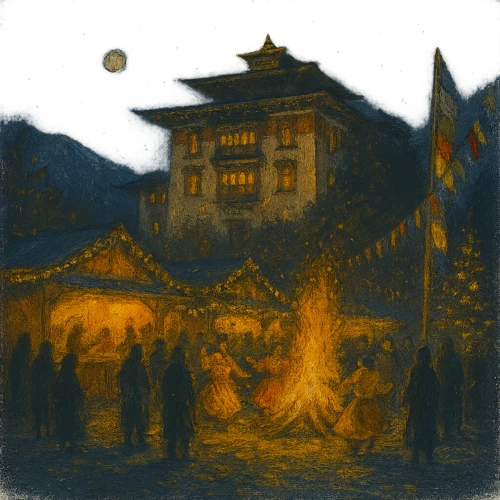
Chapter Nineteen: The Festival
The dawn of Lomba came with music—not loud, but a soft, rolling hum that slipped through the Sanctuary like breath through a sleeping giant. Bells rang in the distance, small at first, then gathering strength as the mountain winds carried their echoes down into the courtyards. The air was crisp enough to sting but bright, alive, threaded with the faint scent of juniper smoke.
Elias woke to it.
For a moment he lay still, the echoes of the previous night still clinging to the silence behind the new day's sounds. The deep chants were gone, the solemn weight of the ceremonial porridge lifted. In their place, a vibrant anticipation pulsed freely. It thrummed through the floorboards, vibrated in the laughter from outside, echoed in the purposeful footsteps filling the corridors.
He sat up, rubbed the sleep from his eyes, and opened the window. A breath of cold air rushed in — clean, sharp, threaded with spices he didn’t recognize. Below, the Sanctuary was alive with color and motion.
Colorful triangular flags fluttered between rooftops. Children dashed past, waving red and gold streamers, their cheeks flushed. The stone corridors were lined with carved lanterns shaped like lotus petals. Monks moved in orderly lines, carrying trays of offerings or bundles of incense wrapped in green twine.
Elias smiled despite himself. He had never seen anything like it.
A knock on his door broke his reverie. Before he could answer, Julian burst in — wearing an embroidered dusk brown robe that looked one size too small for him.
“There you are!” Julian said, hands on hips. “Do you plan on greeting the festival from bed?”
Elias blinked. “I didn’t know there was a schedule.”
Reina appeared behind Julian, smacking the back of his head lightly. “Ignore him. He’s been up since dawn because he’s terrified the best festival pastries will run out before he gets his share.”
“That is a survival instinct,” Julian said with dignity. “A perfectly valid one.”
Naomi leaned against the doorway, arms folded. “Come on. First sunrise procession starts in ten minutes. You won’t want to miss it.”
Elias quickly changed into the ceremonial robe Naomi gave him last night. The fabric was softer than his usual wear, with fine silver threads woven through it. He joined the others waiting for him outside, stepping into the crisp morning
The main courtyard was unrecognizable. The clutter of preparation had given way to rows of long wooden tables draped with embroidered cloth of sapphire and emerald. Bowls of seed offerings and carved candles lined the edges. Monks in deep crimson robes moved with a quiet grace, lighting incense and adjusting prayer flags.
And at the far northern side — beneath the great carved balcony — stood a raised ceremonial stage decorated with bronze-gilded wheels and polished wooden pillars.
People filled the courtyard—men women in the robes of all Seven Circles, monks carrying trays of offerings, and children chasing each other with ribbon streamers. Near the front, sitting beside Miraya on a cushioned platform, was a woman in robes of deep maroon and gold.
Naomi followed his gaze. “Princess Dechen Yangzom,” she said quietly. “She represents the royal family. They are descendants of one of the Awakened—a bloodline pact from centuries ago.”
“So they always come?” Elias asked.
“Every year,” Reina confirmed, leaning in. “A representative comes to renew the royal vow—to protect the Order and its secrets.”
Kiran and Alistair stood at the edges of the gathered crowd, ensuring everything moved smoothly, occasionally exchanging quiet words with one another. Even Lucien, who usually looked impatient with gatherings, stood near the stage with disciplined stillness and a ceremonial staff in hand.
Snowflakes drifted lazily from the brightening sky. A hush rippled through the crowd, and then the music began.
A line of monks approached from the southern corridor, chanting in deep, resonant voices that vibrated in Elias’s chest. They carried long wooden horns carved with dragons, blowing through them as they marched. The sound was haunting and beautiful — a rising, mournful note that echoed off the mountains like a call to old gods.
Children followed, scattering petals. Then came the dancers — four women dressed in red and white, each holding a circular mask depicting a smiling spirit. Their movements were slow, deliberate, weaving through the courtyard with steps that marked time older than any calendar.
Julian leaned close. “Last year one of them fell into the rice baskets. Absolute highlight of the festival.”
“That’s cruel,” Reina said, though a smile played on her lips.
The dancers reached the front of the courtyard, moved aside, and the chanting stopped.
Miraya stepped forward.
Her presence alone hushed even the fidgeting children.
“Today,” she said, her voice carrying without effort, “we welcome the new year. A year of renewal, of letting go, and of remembering the ones whose footsteps carved our path.”
She glanced toward Elias — just for a heartbeat — and he felt it like warmth against cold.
“Let the stories guide us, as they guided them.”
She raised her hand. A deep drumbeat sounded and the performance began as the stage scene unfolded with surprising skill.
Young monks and artisans had prepared props for days—painted backdrops of mountains, cloth rivers, small model huts. The storyteller—a young girl with a voice clear and carrying as a mountain stream—stood to the side while actors played out the scenes.
A warrior entered the stage. He wore simple leather armor, a broad-bladed sword across his back, and a heavy cloak stitched with crude symbols of protection. His long, dark hair was bound in a knot. The actor was young, but his presence captured something essential—weight, burden, stubborn endurance.
“Ravos the Unyielding,” the storyteller intoned. “A guardian of the old age, who rose each time he fell, even when the world asked more of him than he could give.”
Elias felt a faint pull in his chest, the way one reacts to a sound that is familiar but out of place.
The first village appeared — a handful of huts, families bundled in thin blankets. The actors showed hardship without melodrama, gathering firewood, patching roofs, sharing the smallest portions of food. Ravos carried water, chopped logs, fought through a blizzard to bring back a missing boy.
A little girl with a red yarn braid shivered in his arms.
When she stilled, the courtyard didn’t gasp; it simply quieted, the way people do when a truth they know too well is spoken aloud.
Naomi’s fingers brushed Elias’s sleeve, light and brief. He didn’t look away, but his jaw tightened.
The backdrop shifted — orange fabric flickering like flames, smoke drifting from incense pots. Raiders attacked. Ravos fought bravely, swords clacking, shields splintering.
The village elder — played by one of Kiran’s apprentices — fell, his weight slumping into Ravos’s arms.
“Why does he die?” Elias whispered.
“Because sometimes even the strongest fail,” she whispered. “The story doesn’t pretend otherwise.”
He nodded once, thoughtful rather than shaken.
The set changed again. Snow-colored cloth unfurled. Actors moved slowly, as though weighed down by cold.
Ravos walked alone through empty homes.
In one, he found a woman and her child, both fading. The woman’s voice was barely above a breath: “Why did no one come?”
The actor playing Ravos knelt, hands trembling not with dramatics but with quiet, exhausted helplessness. He lit two small lanterns and placed them in the river of painted cloth.
“For the first time,” the storyteller said softly, “Ravos felt his strength break.”
The courtyard held a respectful stillness.
An actor dressed as an old man with a long beard the color of snow approached Ravos onstage, touching his shoulder.
The elder looked at him, his eyes holding a deep and weary sorrow. “You cannot save everyone,” he said, his voice low but carrying across the silent courtyard. “No force of will, no strength of arm can change this. But to stop trying? That is the only true failure.”
Ravos rose slowly — not healed, not redeemed, just standing.
And the storyteller spoke: “We honor Ravos not because he saved all, but because he never turned away.”
The last drumbeat faded. Applause rose — warm, genuine. Children cheered. The princess nodded with bright seriousness. Miraya bowed her head, eyes soft.
Elias exhaled slowly, the story leaving behind not a wound, but the ghost of a feeling he couldn't name.
Naomi watched him for a moment. “What did you think?”
He searched for the right words. “It was… honest. Harsher than I expected. But honest.”
“That’s why we tell it,” she said with a small smile. “Some truths offer no comfort, only necessity.”
After the performance, the solemn mood shattered into joyous chaos. Children sprinted toward the pastry stalls, shouting with excitement. The monks dismantled the stage with surprising speed, already preparing the space for the midday feast.
Elias found himself pulled into the flow of celebration before he could even gather his thoughts. Naomi handed him a steaming dumpling, Reina tugged him toward a table where someone was pouring warm spiced milk, and Julian — already chewing something — declared that eating was the first sacred duty of Lomba.
The courtyard was alive.
Small braziers burned juniper branches at the corners. Lanterns cast swaying patches of red, gold, and amber across the stones. Groups gathered in circles, telling stories or singing old folk songs unique to the valley. Others prepared ritual offerings of seeds and colored powders, arranging them in intricate spirals on carved wooden trays.
Elias had never been at the heart of such vibrant, unguarded camaraderie. It was strangely grounding.
A quiet weight still sat within him, a sober counterpoint to the festive air, but for now, he let the celebration pull him forward.
“Here,” Naomi said, placing a carved wooden cup in his hand. “You’re looking too serious. Lomba isn’t meant for deep thinking.”
“What’s in it?” he asked.
“Sweet rice drink. The non-alcoholic one. For now.”
Julian leaned in, whispering loudly, “The alcoholic one is at the far table guarded by three monks and an angry grandmother. Don’t try to take it unless you want to be publicly shamed.”
“Or blessed,” Reina added. “Hard to tell which is which during Lomba.”
Elias laughed.
They drifted between groups until they reached the long table where the council members stood greeting people. Princess Dechen Yangzom was still speaking with Miraya. Kiran was distributing small carved tokens to children, Alistair conversed with an elderly monk about the opening ceremony, and Lucien held position nearby — ceremonial staff in hand, posture rigid but not hostile.
Naomi nudged Elias lightly and nodded toward them. “Heads up.”
He followed her gaze to where two figures approached from the far side, both wearing robes with distinctive Circle colors.
The first was a woman of serene presence — tall, with smooth dark hair braided down her back, wrapped in robes of pale sage. Her eyes were gentle but penetrating.
The second was a smaller woman, dressed in midnight blue. She moved like a shadow that had learned to be human — precise, silent, impossibly observant. Her face was calm, but her gaze took in everything in a single pass.
Naomi stepped forward. “Elias, this is Master Chiara, Head of the Healers.”
Chiara held both his hands gently in greeting. “I’m honored to finally meet you,” she said. Her voice was warm, steady — the kind of voice that could calm a battlefield.
“Thank you,” Elias said, feeling slightly disoriented by how… present she was.
“And this,” Naomi continued, “is Master Lan — Head of the Watchers.”
Master Lan inclined her head. Not a bow, not a gesture of authority. More like an acknowledgment between equals.
“I’ve been observing you,” she said softly.
Elias blinked. “I… hope that isn’t a bad thing.”
“It is my responsibility to observe,” Lan replied. A faint hint of humor touched her eyes. “If it were a bad thing, you would know.”
Naomi stifled a laugh.
Chiara smiled. “Don’t let her frighten you. She speaks more gently than she looks.”
Lan raised an eyebrow. “I look gentle.”
“Of course you do,” Chiara said, patting her arm.
For a moment, the four of them felt like an odd circle of warmth amid the bustling courtyard.
Chiara turned back to Elias. “You’ve been among us for some time now. I hope the Sanctuary has started to feel like home.”
“It has,” Elias said honestly. “More than I expected.”
“I imagine it’s been overwhelming,” Chiara said, her expression softening. “New place, new people, old truths beginning to stir.”
She studied him for a moment—not invasively, but perceptively. “If ever you feel unsteadied, my doors are always open.”
“Thank you,” Elias said quietly. “I appreciate it.”
Master Lan stepped closer. “I saw the spar with that Guardian last week,” she said simply.
Naomi bristled. “Elias didn’t do anything wrong.”
“I’m aware.” Lan’s voice was cool, even. “My concern was not with Elias.”
Elias raised a brow. “Tarek?”
Lan nodded. “He was disciplined immediately. But today,” she added, glancing toward the royal platform, “all Guardians are on ceremonial duty for the princess. Extra security. It means other areas are lightly watched.”
Elias didn’t think much of it. The Sanctuary was enormous — surely they didn’t need guards at every corner.
Chiara clasped her hands. “We won’t keep you. Enjoy the day. The festival is meant for joy, not council matters.”
Lan offered one last subtle nod, which somehow felt more sincere than most smiles, then glided away toward a group of Watchers.
Chiara followed in a more earthly manner, stopping to greet three elderly women who insisted she sample a pastry.
Naomi watched them go, then nudged Elias. “You survived. See? Council members are people too.”
Elias exhaled. “I don’t know if that’s reassuring.”
“It should be,” she said. “They like you.”
“How can you tell?”
“You’re still alive.”
“Comforting.”
She laughed and pulled him back toward the growing crowd.
As the morning stretched toward midday, the Sanctuary brimmed with energy.
Elias watched a group of children decorate wooden masks with chalk and berry dye. An old woman taught them how to paint the features properly so the spirits would “recognize their own reflection.” A few young artisans demonstrated a traditional hammering rhythm on copper bowls, creating ringing harmonics that danced through the air.
Julian attempted to juggle three rice cakes and failed spectacularly, prompting a grandmother to swat him with a broom.
Reina guided Elias through a stall run by people from the lower valleys, their tables piled with woven scarves and hand-dyed cloth. Most spoke Bhutanese, but when anyone addressed Elias, they seamlessly shifted to English — some fluently, others softly accented but warm.
Naomi explained it quietly: “Everyone in the valley knows English — because the Order brings people from everywhere. It’s a glue language.”
Of course, Elias thought. It made perfect sense.
After a long stretch of feasting and music, Elias stepped away from the center of the courtyard. The noise was pleasant, but constant. His head ached faintly from the blend of incense, smoke, and overlapping conversations. He needed some air.
He followed a narrow side path shaded by prayer flags that fluttered like bird wings. The snow was thinner here; the warmth from the stone walls had melted much of it. Beyond the path lay a quieter terrace overlooking the southern cliffs. It was scenic, peaceful, and nearly empty.
He passed a group of monks carrying crates of lanterns to the upper balconies. A pair of Guardians jogged down the eastern steps toward the main courtyard. No one paid attention to him.
Something in that peace drew him further. He had heard Julian joke about the “western tunnels” several times, always with ominous mystery. Elias wasn’t sure why the idea lodged itself in his mind now — maybe the solitude, maybe the way the festival noise felt overwhelming all at once.
Just a quick look, he told himself. Nothing more.
He followed the terrace as it curved westward. The walls here were carved with older symbols, weathered by generations. No lanterns hung in this part of the Sanctuary; this section wasn’t meant for festival gatherings.
A pair of stone pillars marked the end of the terrace.
Beyond them, a set of broad steps descended into a shadowed alcove.
A narrow archway stood there. It looked ancient, half-covered in moss, its carved lintel darkened by frost. He recognized nothing about its design. It felt separate from the bright world behind him—quiet, old, and unguarded.
He listened carefully, scanning the deserted path around him. From the heart of the Sanctuary, the muffled sounds of music and laughter echoed, a remote celebration. But here, the silence was broken only by the wind. No one was near the west.
Probably temporary, he thought. Lan had warned that they were spread thin for the princess’s visit.
Still… he found himself drawn to the archway out of curiosity, and maybe a little foolishness.
He stepped forward, down the last few steps, stopping just before the tunnel entrance.
A cool draft breathed from within — faint, unfamiliar, tinged with the scent of stone untouched by sunlight.
Elias exhaled, steadying himself. He wasn’t inside yet. Not quite. But the shadows beyond the archway felt like the edge of an unknown world, waiting.
The cold deepened the moment he crossed beneath the stone archway. Not the clean, sharp chill of mountain air — this was a different cold. It settled onto his skin like a damp cloth, quiet and invasive. His breath fogged in front of him.
A faint line of torches flickered along the walls, set in iron brackets at irregular intervals. Their flames were small, wavering, as though struggling to cling to the air. They cast long shadows that reached like fingers across the stone floor. The light barely reached the ceiling; the rest of the tunnel was swallowed in a persistent dusk.
Elias took a slow breath, letting his eyes adjust.
Walls carved from dark stone stretched forward in a narrow corridor. No windows. No openings. Just the rhythmic pattern of torchlight and shadow. The silence was near complete — so utter that his footsteps sounded too loud, too sharp, as though they didn’t belong.
He walked deeper. At first, it was simple curiosity. The kind that nudged him to look around a corner or open a forgotten door. But the further he went, the more something inside him... shifted. A subtle tug. Like the afterthought of a memory. Not urgent, not commanding—just a quiet pressure behind the ribs, urging him forward.
Elias slowed, testing it. The sensation didn’t fade when he stopped walking—but it didn’t grow either. It merely waited. His throat tightened. Not now, he told himself. Don’t imagine things.
He continued. The first set of cells appeared on his left — iron bars, thick but rusting at the edges, set into deep alcoves carved straight from the mountain. Elias hesitated, glancing inside.
Empty. Nothing but dust, old straw, and the faint smell of stone that had been cold for centuries.
The second cell mirrored the first — he found the remnants of an old cot, long decayed, and an abandoned wooden bowl. But nothing else. No movement. No presence.
Elias exhaled, forcing himself to relax. Maybe this wing hadn’t been used in years. Maybe its reputation was more myth than reality.
But the pull persisted. He moved on. The torches grew sparser. Their flame burned lower, as though the air thinned this far down. A faint hum — almost too soft to be sound — brushed against Elias’s awareness, like fingers trailing along the edge of his senses. His heart quickened.
Then he saw it. At the end of the corridor, one cell was different. Its bars were newer — solid black metal reinforced at every joint. Strange sigils were etched into the vertical beams, glowing faintly with a copper hue when the torchlight touched them. The carved symbols were curved, almost organic, winding like roots or veins.
He stepped closer. Inside, sitting on a bed carved directly into the stone wall, was a man.
Dark-skinned and broad-shouldered, he held himself with the stillness of an ancient tree. His hair, tied back, was more silver than black now, like frost over earth. He wore simple, unadorned clothing—nothing like the ceremonial robes of the Sanctuary.
At first, Elias thought the man hadn’t noticed him. But then — with the smallest shift — the prisoner lifted his head. Their eyes met. Elias froze.
The man’s eyes were deep — not in color, but in weight. As though behind them sat a lifetime Elias couldn’t begin to measure. There was no hostility, no fear. Just an intense, quiet recognition that struck like pressure beneath Elias’s sternum.
Not that Elias knew this man. He didn’t. But there was something familiar about him. And the way the prisoner looked at Elias—it was as if he were seeing something beneath the surface. As though he were studying the shape of Elias’s soul, tracing its contours.
Elias inhaled sharply. The man stood—slowly, deliberately, unhurriedly. He moved with the calm of someone who had lived inside a storm for long enough to respect silence. He stepped toward the bars, stopping just short of them. The sigils flared faintly in response to his closeness, like defensive breath.
Still his gaze did not leave Elias.
Elias took half a step forward without meaning to. “Do I… know you?”
The man didn’t answer. He only looked at Elias, eyes steady, ancient, unbearably gentle — and unbearably sad.
A shiver crawled down Elias’s spine. The moment stretched, silent and heavy. Then, a sound—so soft it was almost not a sound at all—came from behind him. "You are not supposed to be here."
He turned sharply. A tall woman stood behind him, robed in dusk brown, her hair braided tight to her scalp and wrapped in silk. Her skin was the color of night sky, and in the faint light, she seemed to emanate a calm, formidable stillness. Her presence was quiet, not imposing, but she carried an authority that sank into the air like gravity shifting.
Elias hadn’t heard her approach. He hadn’t even felt her presence.
She stepped into the light of a torch, revealing calm, steady eyes that seemed to hold more understanding than she ever spoke aloud.
“I startled you,” she said gently. “Apologies.”
Elias exhaled, pulse racing. “I—I didn’t hear you.”
“You weren’t meant to.”
She swept past him, pausing before the cell. Her eyes flicked once toward the prisoner. He bowed his head to her in silent acknowledgment; she returned it before turning back to Elias. “Walk with me.”
He swallowed. “I… didn’t mean to trespass. I didn’t know—”
“Yes, you did,” she said softly, but without judgment. “Curiosity is not a crime. Curiosity brought half the First Ones to their destinies.”
She began walking, her footsteps making no sound on the stone floor.
Elias hurried to catch up.
As they moved away from the cell, the pull in his chest eased — slowly, like a held breath finally released. Elias glanced over his shoulder.
The man was still watching him.
Imani did not.
“I’m Master Imani,” she said, voice poised. “Head of the Hidden Ones.”
Hidden Ones. The words struck him with instant awareness—an entire world of meaning he didn’t yet know, but felt.
She must have seen the shift in his expression. “You have questions,” she said.
“Many,” Elias admitted.
“Choose one.”
Elias hesitated, then asked the one that burned most bitterly: “That man… why is he imprisoned?”
Imani’s steps did not slow.
Her voice remained calm. “Some people are kept here because they are dangerous.”
“Dangerous how?”
“Power without balance,” she said quietly. “Hope without restraint—or grief without direction.”
Elias frowned. “That sounds poetic.”
“It is,” she admitted. “But it is also the truth.”
He looked at her. “And him?”
The silence between them stretched, broken only by the drip of water in the tunnel's depths. Imani's steps slowed as she breathed out. “He once protected this place with his life. And then...” Her voice softened even further. “He could no longer protect even himself.”
They reached the foot of the stairs leading up to the terrace.
“That is all I will say,” she finished gently. “For your sake. And for his.”
Elias swallowed hard. He didn’t understand, not fully. But something in her tone — maybe the sorrow beneath it — kept him from pressing further.
When they reached the archway, the sunlight hit him like a warm slap. He blinked, disoriented. The noise of the festival drifted toward them — laughter, drums, distant singing.
Their silent walk carried them into the main courtyard, and a moment later, Naomi was cutting through the crowd toward them.
She offered a swift, respectful nod first. "Master Imani." Then, her focus shifted to Elias, her voice tight with concern. “There you are. I’ve been looking everywhere. Where did you go?”
“Our paths converged,” Imani replied. “And we had a small conversation.”
Naomi looked between them, suspicion rising… then fading as Imani’s presence eased it out of her.
Imani turned to Elias. “Enjoy the rest of Lomba.”
He nodded. “Thank you.”
“And Elias?”
He looked up. He thought he saw something like a small smile touch her lips.
“Next time,” she said softly, “try to be more careful.”
Then she turned and disappeared into the crowd, as though she had never emerged from the shadows at all.
Naomi stepped closer. “What happened?”
Elias didn’t answer immediately.
The cold of the tunnels clung to him. The memory of the man’s eyes clung even tighter. He felt as though something fragile inside him had been nudged.
“I just wandered too far,” he said finally.
Naomi studied him — really studied him, but didn’t push. She slipped her arm through his. “Come on. The archery match is about to start. Julian is convinced he’s going to win this year.”
Elias followed, letting the warmth of the celebration swallow the chill still lingering beneath his skin.
But as they made their way to the archery grounds, he couldn’t shake the image of the man behind the sigiled bars — standing, silent, staring at him as though he knew a truth Elias had not yet learned to fear.
In the late afternoon, the formal ceremonies of Lomba gave way to quiet reflection. As the sun began to sink behind the mountain peaks, casting long, cold shadows, the festive energy softened into a collective, watchful silence.
The moment the sun vanished, leaving the sky in a deep twilight blue, a single, resonant horn blast echoed through the valley. It was the signal. All across the courtyards, hundreds of lanterns were lit, their colored light blooming like sudden flowers against the dusk, pooling on the ancient stones. The air grew colder, sharpening the scent of spiced tea and pine smoke.
Julian and Reina found Elias, their earlier boisterousness replaced with a reverent excitement. "It's time," Reina said, carefully handing him a lit lantern. Its warm glow flickered behind the colored paper, and he could feel the gentle heat from the flame within.
They moved to the great western terrace, overlooking the vast expanse of the valley. The entire community stood in a hushed crowd, each person holding their own lit lantern. Naomi stood beside Elias, her face illuminated by the gentle flame.
Another horn blast. As one, the community raised their lanterns. On the third and final note, they released them.
A silent, glowing river of light rose from the mountain, a thousand individual hopes and prayers drifting into the darkening sky. They carried the old year's sorrows and the new year's promises up to meet the first, brave stars.
Elias watched his own lantern, a tiny, fragile light, disappear into the great constellation of others.
As the last lantern drifted from sight, the mood shifted. Musicians struck up lively tunes on long-necked lutes and hand drums, and people began to dance in circles beneath the emerging stars. Julian and Reina dragged Elias into two dances—both of which he barely managed to keep up with. Nearby, even Marcus and Valerie had joined the fray, their movements more reminiscent of a sparring match than a dance. Naomi watched from the sidelines, looking on with a knowing smile.
Slowly, the self-consciousness from his clumsy dancing faded. He found himself simply moving through the crowd, and wherever he stopped, men and women drew Elias into their circles, offering pastries, telling jokes he didn’t fully understand. And through it all, Elias noticed something strange—he was not an outsider anymore. He was one of them.