Chapter Two: The Life Outside the window
The dream ended the way it always did: with the cold, absolute silence of loss.
For a moment, he was not in Boston. The air was thick with dust and the scent of cheap lamp oil. He was kneeling on a hard, dirt floor, his hands—chapped and unfamiliar—pressing a damp rag to a child’s forehead. He did not know her name, but a love as vast and desperate as a sinking ship filled his chest.
Her breath was a thin, fraying thread. Each rattling inhale pulled at something primal in him. He heard himself humming a tune he did not know, a low, aching melody meant to soothe. Her small fingers twitched against his wrist, and the contact felt like a hook set deep in his soul, a connection he could not explain.
He watched the life leave her. It was not a dramatic end, just a gradual stillness, a final sigh that left a void more profound than the dark, cramped room. The love did not vanish with her breath; it collapsed in on itself, turning into a weight of failure so absolute it crushed his own lungs.
He didn't even know who she was, only that he couldn't save her. It felt like a part of him had just ceased to exist, and he was left, utterly helpless, holding the shell of a stranger who felt more essential than his own heartbeat.
The scene fractured, dissolved into the dull ache of the present.
The room was quiet enough that Elias could hear the faint hum of the fluorescent light above him. It was not a soothing kind of quiet. The silence had the same sterile, deliberate weight as everything else in this room: the careful arrangement of books along the shelf, the small clock on the table that ticked without apology, the box of tissues set just close enough to reach.
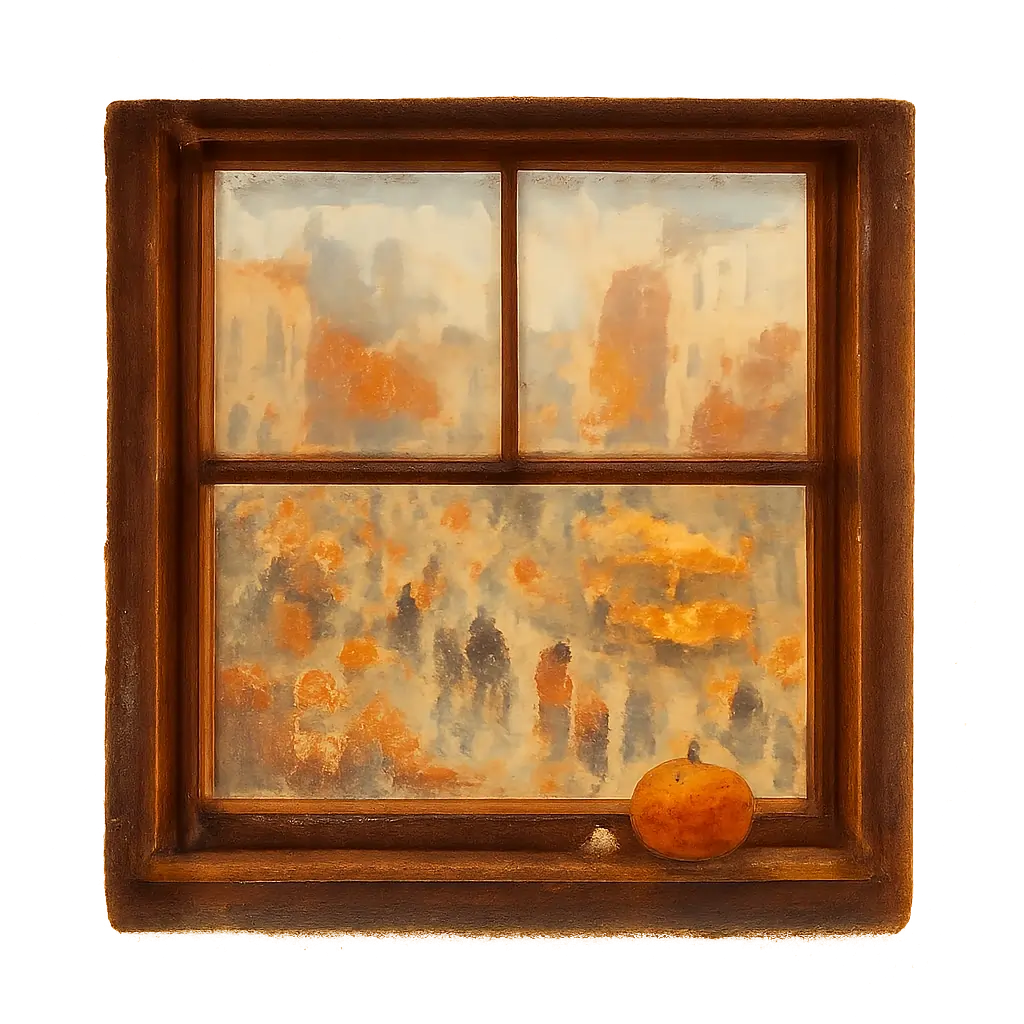
He sat on the couch, body sunken deep, one arm resting along the edge, the other across his lap. His eyes weren’t on her. They were on the window.
From this fourth-floor vantage, the city seemed to move in miniature. People streamed along the sidewalks below, bundled against the mid-autumn chill, their coats fluttering behind them as they hurried to appointments, lunches, errands. Yellow buses rumbled past, brakes hissing, doors opening and closing with hydraulic sighs.
On the porches below, plump orange pumpkins and skeletal figures made their first tentative appearance, marking the calendar’s shift. A man in a delivery uniform balanced three boxes stacked higher than his head, swaying dangerously as he shuffled toward the corner. A couple crossed the street hand in hand, laughing about something unseen, their faces lit with the kind of warmth Elias felt had been denied him.
Inside, the air was warm, still, contained. Outside, life churned forward, indifferent.
“Elias.”
The voice cut through. He blinked, pulling himself from the window and toward the room.
Dr. Maren sat in her armchair across from him, pen poised above her notepad. She had a calm face—steady eyes, steady voice—but Elias sometimes wondered if her calm was genuine or simply trained, the product of years of listening to grief, rage, despair.
“You seemed far away just now,” she said softly.
He shifted on the couch, running a hand over his wedding ring. The coldness of the metal was a familiar shock, a tangible reminder of Clara's absence. "I suppose I was," he said, his voice dropping low.
“How have you been?” she asked.
It was the same question every week, but it never grew easier. How did one measure grief? By the number of nights he choked on Clara’s absence? By how many hours he sat at the grave without speaking? By how often the world outside felt like an alien planet?
“I’ve been… going through the days,” he answered finally. “One after another.”
“That’s all right,” Dr. Maren said. “Sometimes survival itself is the work.”
He nodded, though the words felt hollow. Survival wasn’t living. It was standing still while the world moved on.
They sat in quiet for a moment. He could hear the muffled rush of a siren far below, the sharp bark of a dog, a child’s laughter bouncing faintly against the glass. His chest tightened.
“You’ve been coming here since Clara’s diagnosis,” Dr. Maren reminded him gently. “You wanted to be strong for her, to have someone to share the weight with. Do you feel like it’s helped?”
Elias let the question hang. Did it help? For the past four weeks, hers was the only voice, the only human presence, he had allowed. He came because the alternative was collapsing inward, because the silence of his apartment threatened to devour him whole. Sitting here, at least, gave shape to the pain.
“Some days it feels like words can’t reach it,” he said at last. “Like talking only makes me circle it, never touch it.”
Dr. Maren didn’t push. She simply nodded, making a note.
“And the dreams?” she asked. “Are they still coming?”
Elias leaned back into the couch, exhaling slowly. The dreams. They had followed him long before Clara’s illness, long before this office. He had tried, for years, to bury them, to smother them in daylight. But lately they had returned with a vengeance.
“Yes,” he admitted. “Almost every night.”
“Tell me about them again.”
“They’re not always the same. I’m often in places I don’t recognize. Old streets, fields, forests. Sometimes whole cities, with strange buildings. People surround me—people I don’t know, yet when I see them, I feel as though I love them, as if they’ve always been a part of me. And then… they’re taken away. Always. Sometimes by violence, sometimes by sickness, sometimes they simply vanish. But the grief feels the same. As if I’ve lived their loss a thousand times before.”
Dr. Maren’s pen slowed on the page. “What else?”
He nodded, eyes drifting again to the window. “They speak in tongues I shouldn’t understand. Words that I've never heard before. And yet when they speak, I know. Every word, every meaning. It’s like… memory I never lived.”
“You called them nightmares before.”
“They are. Because every time I wake, I feel hollowed out. It’s grief layered on grief. I lose Clara in the day, and I lose strangers in the night. I never stop losing.”
His voice caught, and for a moment he said nothing. A bus roared below, brakes squealing, laughter carrying faintly upward.
Dr. Maren shifted, crossing one leg over the other. “Do you know what some people would call these dreams?”
He gave a dry laugh. “I can imagine.”
“Reincarnation,” she said plainly. “Memories can sometimes surface in dreams,” she had said. “Things you can’t explain. A sense of knowing, of recognition. Some people believe those are fragments of past lives.” She looked him in the eyes, and continued: “Sometimes, the soul carries unfinished stories. They resurface when it’s time to remember.”
Elias let out a sharp breath, halfway between amusement and anger. “You don’t believe that, do you?”
She met his gaze steadily. “Belief isn’t the point. I’m saying some people find meaning in framing it that way.”
He shook his head. “Meaning is just a story we tell ourselves when reality is unbearable. I don’t believe in reincarnation, or heaven, or spirits whispering through dreams. When we die, we die. That’s it. End of story.”
Her expression didn’t change, though her pen hovered above the page. “And yet the dreams feel real to you.”
“They feel like punishment,” he muttered. “As though my brain is inventing new ways to remind me how alone I am.”
His gaze drifted again to the glass. Below, a boy pedaled his bicycle through a puddle, spraying water onto his friend who chased after him, laughing. A woman leaned out of a bakery doorway, shaking out a rug. Music drifted faintly from a passing car, bass thumping, windows rattling. The world went on, relentlessly alive.
“Do you ever wonder,” Dr. Maren asked quietly, “if the losses you dream of are connected to the loss you felt as a child?”
His throat tightened.
He rarely spoke of it, though she had asked before. Still, the words came now, unbidden.
“I was seven,” he said slowly. “We were driving home late—my mother, my father, me. It was raining hard. I remember the windshield wipers working faster than seemed possible, but the glass was still a blur. And then… lights. A horn. Metal screaming.”
He stopped, swallowing hard.
“They told me I was lucky. That somehow I crawled from the wreck. I remember sitting on the grass, soaked, watching strangers pull twisted metal apart to reach bodies I already knew were gone. My parents died instantly. I knew it before they told me. And just like that, I was no one’s child.”
The office blurred for a moment. He blinked against it, staring hard at the window.
“They sent me to a home,” he continued, voice flatter now. “Rooms full of other orphans, all of us waiting for someone to want us. No one ever did. I grew up there, among strangers who came and went. You learn quickly not to hold on to anyone. Everyone leaves. Everyone.”
His hands clenched in his lap. “So maybe the dreams are nothing mystical. Maybe they’re just the echoes of that first loss, repeating. My brain staging tragedies with new faces, because it can’t stop replaying the first one.”
Dr. Maren’s voice was calm, but her eyes softened. “That’s one way to see it.”
“And what’s your way?” he asked bitterly.
She paused. “Sometimes I wonder if dreams carry truths we’re not ready to face in daylight. Whether they’re memories, symbols, or something else—perhaps they’re trying to tell you that loss has shaped you more than you realize.”
Elias scoffed, though the sound rang hollow. “Or maybe they’re just dreams. Neurons firing. Random nonsense.”
“Do you really believe that?”
He didn’t answer. His eyes had fixed again on the street below. A group of teenagers clustered at a bus stop, sharing a phone screen, their laughter erupting in sudden bursts. A man in a business suit rushed by, talking furiously into his earpiece, his hand slicing the air. A small child in a bright red coat skipped along the sidewalk, holding tightly to her mother’s hand.
Life. Endless, unstoppable life. And him, behind the glass, as though trapped on the wrong side of the world.
“I believe,” he said finally, “that Clara is gone. That my parents are gone. That I’m alone. That’s what I believe.”
Dr. Maren’s voice was gentle. “And yet you keep coming here.”
He turned to her at last. “Because if I stop, I might vanish too.”
The clock ticked on, steady and unfeeling.
They sat in silence for a while, the air dense with things unsaid. Elias leaned back, staring once more at the window. He thought of the girl at the cemetery—the strange child in black who had spoken of wings. He hadn’t told Dr. Maren about her, not yet. Perhaps he never would. Perhaps the thought of her was too fragile to place in someone else’s hands. For weeks now, on every visit, he had scanned the rows of stones, hoping to see her again. It was a fool's hope, he knew, but he was a man with too many questions, and part of him believed she might hold an answer.
The session wound toward its close, as they always did, with Dr. Maren reminding him of next week, her voice calm, her presence steady. Elias nodded, though his mind was already beyond the walls, drifting through the noise of the city below.
When he left the office, the air outside hit him sharp and cold. The sky was breaking open to dusk, streaked with bruised purples and dimming golds. People surged around him, their conversations, their footsteps, their laughter colliding in the evening air. He walked among them, silent, lost.
And though he mocked it, though he denied it, the word reincarnation lingered in him like a splinter. He couldn’t shake it free. There were so many questions in his mind that he had spent a lifetime suppressing, but not anymore. He was looking for answers now, but... was he desperate enough to let go of his core beliefs—to step beyond the only reality he had ever trusted?