Chapter One: The Cemetery
The cemetery held its silence like a clenched fist. It was not the soft quiet of a library, nor the fragile hush before sleep, but a silence that weighed on the chest, as if the earth itself refused to breathe. The sky sagged gray and low, pressing damp air against the ground, still heavy from last night’s storm. The paths glistened dark with rainwater, and the grass, beaten flat, seemed too tired to rise again.
Ravens crowded the trees at the edges of the cemetery. The birds perched along the branches, their black forms sharply defined against the dense autumn canopy. They shifted restlessly, wings shuddering, claws scraping bark. Their coarse calls cracked the stillness every few minutes, and each time it sounded like a wound tearing open.
Seven days had passed since Clara was lowered into the ground. A week since he stood at this very spot while the priest muttered words he had not listened to, words that bounced off the wall inside him where nothing could settle. Seven days since strangers offered condolences that felt rehearsed, useless. Seven days since the earth closed over the only person who made his life feel less like a sentence.
He had been here every day since then. Without fail.
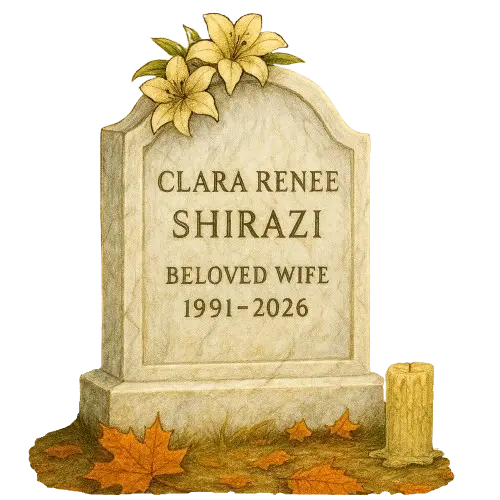
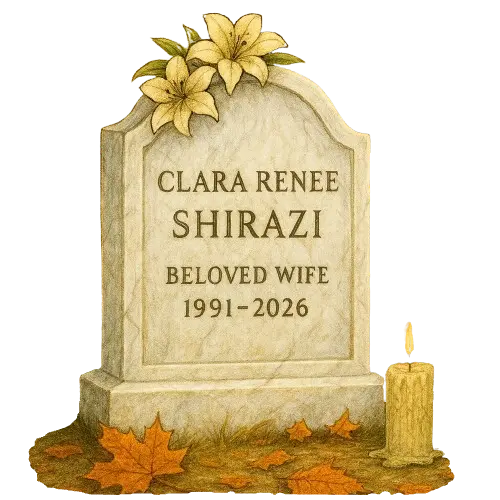
He carried lilies in his hands. Their white petals almost glowed against the gloom, too alive for this place. Clara loved lilies; she used to say they seemed like flowers sculpted from light. He set them carefully at the base of the grave, brushing away the rain clinging to the polished stone.
Clara Renée Shirazi
Beloved Wife. 1991–2026.
The letters cut deep into the marble looked unreal, as if they might vanish with a blink. He ran his fingers across the grooves, needing the proof of touch where sight had failed.
He said nothing. He had nothing to say. His silence was not prayer—he had never been one to pray. Prayer required faith, and faith had been burned out of him years ago. What filled him now was a void, vast and unyielding, as if his insides had been scooped out and left hollow.
Emptiness was the only constant he could trace back through his life. He had been an orphan, growing up within the high, indifferent walls of a state-run home. When he turned eighteen, he exchanged one institutional structure for another and signed up for the Marines.
The Corps gave him a structure that required only obedience, not belief. For years, his world was the dusty Afghan valleys. He returned with an honorable discharge, and a collection of silences that were sharper and darker than the ones he’d carried before. He was a mess—skilled, but lost.
He had no purpose, until he found her.
She was the color he hadn't known his life was missing. She was the one who encouraged him to go to college, who taught him that purpose didn't have to be handed down in orders. She had no one, either. Her parents had died when she was young; she had navigated the world alone until they found each other, two solitary structures finally leaning together, sharing the weight. They only had each other, and for years, that was enough. He realized he had known her for almost half of his life—a fact that now made the pain of losing her feel disproportionate, immeasurable.
Images came whether he wanted them or not. Clara in the hospital bed, her hair thinning, her skin pale as candle wax. The dim hours when her hand in his was the only thing that held him together. She had smiled through it—faintly, stubbornly—as though her small flame of warmth could keep the dark at bay. That smile rose in him now, flickered, and then dissolved into the cold.
He could still feel the chill of the air on the night he proposed, eight years ago. He had planned a dinner reservation, saved for months to buy the diamond, intending a grand, public surprise. But a cyber breach had locked him down at the security firm until late, and they missed the booking entirely.
Instead, they bought two hot dogs from a wagon downtown and walked toward the river. It was early autumn in Boston, the air crisp and smelling faintly of salt and woodsmoke. The trees along the Charles River Esplanade had just begun to turn, scattering faint bronze and copper light onto the water. They found a bench that looked out across the river toward the glowing windows of Cambridge—a silent, glittering landscape of aspiration and intellect.
He hadn't intended to propose there, eating hot dogs wrapped in damp napkins. But looking at her, bundled in his too-big jacket, her eyes reflecting the city lights, the grand plan felt absurd. He dropped to one knee on the cold asphalt. The ring box felt huge and awkward in his hand.
She didn't laugh. She cried, and said yes, instantly. They had been married for seven years—the happiest days of his entire life—until she got sick.
He remembered the night she had asked if he regretted that they never had children. The disease had already taken root in her then. He had told her no, steady and sure. How could he bring another life into a world that only promised sorrow? To him, children were a selfish gamble dressed up as hope. Clara had smiled at his answer, but now he wondered if she had wanted him to lie. That thought cut deeper than the stone before him.
Above, a raven gave a throaty croak, dragging him back to the present. He looked up and saw its feathers ruffle against the wind, black against the gray. Along the branches, the mass of silent birds occasionally shifted, restless and watchful. The individual boughs jerked and sprang under that weight, releasing a small shower of gold and crimson leaves that spiraled down to the ground.
He wasn’t alone in the cemetery. A woman knelt a few rows away, her dark coat spreading into the wet grass, lips moving in silent words he couldn’t hear. A boy stood beside her, tugging impatiently at a balloon string, out of place here, as though he had wandered into a nightmare too soon. Farther down, an old man crept along the gravel path, his cane sinking into the earth, his gaze locked on the ground. Each of them carried their grief differently, but the shape of it was the same—an invisible tether dragging them through this place, through this silence.
And then, unexpectedly, a voice broke it.
“You need to spread your wings.”
He stiffened and turned.
A little girl stood a few paces away, no older than ten. Her black dress clung damp to her knees, her shoes darkened by wet grass. Dark hair framed her pale face, and her eyes—wide, unblinking, and a shade of hazel that, for a heart-stopping moment, reminded him of Clara’s—settled on him with unsettling calm.
She smiled faintly—not in kindness, but with a strange certainty, as though she knew him.
“What did you say?” His voice cracked, low and hoarse.
“Let the darkness loose,” she said—her eyes flicking, briefly, to his hands.
The words lodged somewhere deep, where no memory would reach. They felt foreign, absurd—yet they carried weight. He was not sure what to say.
“Seraphina!” A woman’s voice called from beyond the graves.
The girl turned, but her eyes stayed on him for a long moment. Her smile flickered, lingered, then she darted away between the stones. Within seconds, she was gone, swallowed by rows of granite and the mist that hung close to the ground.
The silence closed back around him, heavier than before. Ravens shifted overhead, croaking as if to mock his confusion. He looked down at the lilies again. Their petals had begun to sag, bruised by the damp, their brightness bleeding into the soil. His chest ached as though the stone pressed down on him too, as though the grave was wider than it looked.
He stayed there longer than he meant to. The cold gnawed through his shoes and into his skin. The damp climbed into his bones. Only when his body trembled did he force himself upright. He followed the gravel path back toward the gates, each step sounding too loud in the heavy stillness.
The gate loomed tall and black, its bars streaked with rust. When he pushed them open, the hinges screeched, the sound breaking like glass against the quiet.
And then he stepped out, and the world changed.
The street was alive. Cars hissed over wet asphalt, tires slicing thin ribbons through puddles. Laughter spilled from a group of teenagers clustered near the corner, their voices bright and careless. Music leaked from a café door, mingling with the smell of coffee and warm bread. A dog barked, pulling against its leash, straining toward the noise and motion.
He paused at the threshold, between two worlds. Behind him, the cemetery crouched in silence, damp and shadowed. Ahead, the city pulsed with color, movement, heat.
Inside him, though, there was something awakened—he couldn’t name it, but it felt strangely familiar. He stood a moment longer, watching life surge around him, and felt like a ghost trapped in a body.
Then he moved forward, carrying the silence with him into the noise.