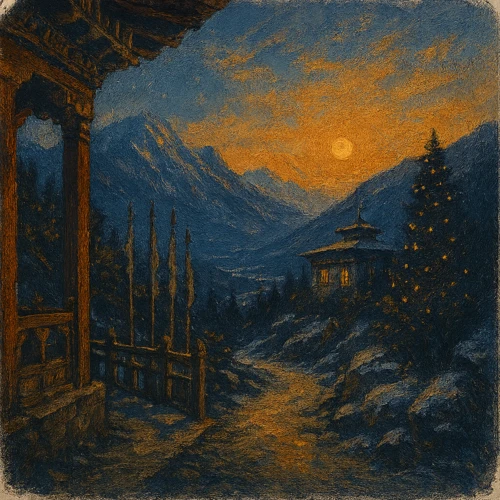
Chapter Seventeen: The Forgotten Angel
The moment Elias crossed the threshold of the Inner Sanctuary, the air itself felt different—thicker, gentler. The corridor carved into the mountain opened before him. Robes the color of ash and river clay moved aside as two monks remained at the entrance, their heads bowed in greeting. One stepped forward and, with a small, hospitable gesture, indicated the hall ahead.
“Welcome, newcomer. The Elder has been expecting you.”
Elias inclined his head, unsure whether to bow or speak; the monk’s faint smile made the choice for him.
As Elias moved forward, the soundscape unfolded around him—soft conversation in distant rooms, the rustle of fabric, the clink of metal and ceramic, the far-off ringing of bells—not tolling, but singing. It wasn’t silence that ruled here but harmony, every motion measured to fit within an invisible rhythm.
Naomi waited for him a few steps ahead. She was out of her coat, dressed in the same robes as the monks but still unmistakably herself—sharp, composed, her short hair framed her face in soft, deliberate lines. When she saw him, her face warmed into a genuine smile.
“You made it,” she said. “I was worried the path might be too much.”
“It wasn’t easy,” Elias admitted, his voice roughened by cold and travel. “But… I think that was the point.”
Her smile deepened. “That’s how the Order knows you’re ready.”
They began walking side by side through the long corridor. The walls soon gave way to open galleries, the ceiling rising high enough to make him pause. He hadn’t expected such vastness inside the mountain. Sunlight poured down from unseen openings above, breaking into shifting bands through veils of incense smoke.
Along the edges of the hall, dozens of people moved quietly—robes flowing in muted hues, some carrying scrolls or tools, others tending to fires, polishing copper bowls, or arranging bundles of herbs.
Children in bright, handwoven cloth darted between ankles and pillars, bare-kneed and curious—one clutched a chipped wooden yak while another traced the gilded edge of a prayer wheel.
He had expected solemnity. What he found instead was life—laughter in the corners, soft greetings passed between those who clearly knew one another. The air carried the scent of warm bread and burning cedar.
“It’s… busier than I imagined,” Elias murmured.
Naomi glanced at him with amusement. “You thought we’d live like ghosts?”
He shrugged, watching two young acolytes hang prayer cloths between stone pillars. “I thought you’d live like monks.”
“Some of us do,” she said, “but most of us work. The Sanctuary isn’t a temple—it’s a home. The Order has families, teachers, even children now. Most people here are descendants of the fallen ones, not awakened themselves. But we all keep the same vow—to protect the old knowledge and each other.”
They passed beneath an arch where golden light pooled like liquid. The stone beneath his boots changed texture, becoming smooth, almost warm to the touch. Ahead, the corridor branched into several paths. Naomi led him down one without hesitation, her steps sure and unhurried.
As they walked, he caught glimpses of familiar faces among the robed figures. Reina stepped out from a side hall, balancing a tray of steaming cups. A small smile tugged at her lips when she spotted him.
“Elias!” she called softly. “You actually survived that climb!”
“Barely,” he replied, smiling despite himself. “It’s good to see you, after all that walking.”
“I'm glad you're here,” she said, her grin widening. “I was just telling Julian how much I miss you.”
As if summoned by name, Julian appeared from a nearby stairwell, a folded bundle of papers in his hand. His expression brightened instantly. “There you are! Took you long enough to reach civilization.” He clapped Elias on the shoulder, leaving a faint dust print. “The mountain didn’t chew you up?”
“It definitely tried,” Elias said.
Naomi smiled at the reunion but gestured gently toward a narrower passage. “Come. The Elder’s waiting.”
Julian gave a two-finger salute. “Good luck, man. I’ll be around when she’s done enlightening you.”
Reina chuckled, shaking her head. “Ignore him,” she whispered. “He still thinks the Elder can read minds.”
“She can,” Naomi said over her shoulder, not turning back. “She just chooses not to.”
That shut Julian up for a full second.
They left the main hall and entered a quieter section of the sanctuary. The air grew cooler, still carrying the smell of incense and something faintly metallic, like rain on stone. Murmurs gave way to silence, broken only by the low chant of prayer somewhere distant.
Elias noticed murals etched into the walls—ancient but beautifully preserved. They didn’t depict gods or angels, but people: men and women building, healing, teaching, fighting side by side. Beneath each carving, a single word had been inscribed in a language he didn’t know. He reached out to trace one with his fingers, and Naomi said softly, “Those are the names of the First Awakened—the ones who remembered what they were.”
The words carried both reverence and loss.
They turned another corner, and the space opened once more—this time into a courtyard cut into the mountain’s heart. A ring of terraces surrounded a vast open pool that reflected the sky through a circular opening above. The water shimmered like glass, broken only by the occasional ripple from the slow drip of a carved spout. Along the terraces, people knelt in meditation or tended to lanterns. Above them, prayer flags strung from arch to arch shifted gently in the draft.
Elias slowed, drawn in by the sight. “It’s beautiful,” he whispered.
Naomi followed his gaze. “The heart of the Sanctuary. The water comes from the glacier above. It never freezes, no matter the season. They say it remembers every soul that’s passed through here.”
He couldn’t tell if she meant it literally or not, and didn’t ask. The air itself seemed to hum faintly, like something alive beneath the stone.
A faint voice echoed from across the courtyard. “Naomi!”
They turned to see Valerie approaching, her flight jacket exchanged for an iron-gray robe, worn with defiant ease. Her beam softened when she met Elias’s eyes. “You look like you could sleep for a week.”
“Three days would do,” Elias said.
Marcus appeared behind her, the robe clung to the lines of his muscles. “Welcome to the mountain,” he said simply, extending a hand. “You’ll find it’s the one place that feels older than the world.”
Naomi nodded toward a flight of stairs that curved up along the wall. “We’ll see each other later; we must not keep the Elder wating.”
Valerie gave a mock salute. “Good luck, Elias. Don’t say anything clever. She’ll know.”
He smiled faintly. “That’s reassuring.”
As they ascended, the sounds of the courtyard faded behind them, replaced by the hush of narrow halls. The walls here bore no murals, only simple grooves where water ran in thin, silvery veins. The air cooled further. The faint vibration beneath his feet was like a heartbeat slowed to a meditation rhythm.
At last they reached a heavy door set within a curved arch of black stone. Naomi hesitated just a moment. She glanced sideways at Elias, and something passed across her face—uncertainty, almost vulnerability. “Before we go in,” she began softly, “there’s something you should know. The Elder—”
Before she could finish, the door opened from within. Lucien stepped out, tall and broad-shouldered, the torchlight catching the faint lines of his scars. His presence filled the hallway like a physical weight; his jaw tightened when he saw Elias.
“Naomi,” he said with a nod. Then, glancing to Elias, “You must be the one who survived the mountain.”
“I suppose that’s me,” Elias replied.
Lucien’s mouth curved faintly—too small to be genuine—while his jaw twitched with something like irritation. He turned to Naomi and said, softly but with a hard undercurrent, “Your mother wishes to see you first.”
Elias blinked. “Your what?”
Naomi winced, caught between exasperation and resignation. “I was about to tell you.”
Lucien smirked. “Too late. Consider it done.” Then he inclined his head toward the doorway. “She’s waiting.”
Naomi gave Elias a look that managed to be both apologetic and defiant. “Now you know.”
Elias could only nod, still processing it. The Elder. Naomi’s mother.
Lucien walked away down the corridor, his footsteps fading into the hush.
Naomi exhaled slowly and turned toward the open doorway. “Wait for me here. I won’t be long.”
Elias watched her go. The door closed behind her, and the sound of it seemed to echo deeper than it should have, as though it sealed off more than a room.
He stood there alone, between the quiet stone walls, the faint rush of the hidden river filling the silence. Somewhere behind him, the Sanctuary lived and breathed—distant voices, the soft beat of a drum, the steady rhythm of prayer wheels turning.
It didn’t take long before the door opened with a muted groan—wood dragging against stone.
Naomi stood there, her expression softer now. “She’s ready for you,” she said. Her voice carried an edge of relief—as if she’d been holding her breath inside.
Elias followed her into the room.
The chamber stretched wide, carved directly into the mountain’s inner wall. Rows of wooden shelves lined the walls, filled with books, scrolls, and handwritten ledgers. Plants grew in low clay pots along the floor—ferns, mountain herbs, a flowering vine that climbed up toward the faint light filtering through narrow slits near the ceiling.
The light was soft and golden, drawn from oil lamps set into alcoves, their flames steady and low. The scent of resin and mountain thyme lingered in the air. The furniture was simple: carved tables, woven mats, and a few cushions scattered across the stone floor. There was no throne, no insignia of command—only quiet purpose.
At the far end stood a wide sliding door of pale wood, its panels inlaid with subtle carvings of flowing clouds and interwoven circles.
Naomi stopped halfway into the room and turned. A glimmer of pride mixed with something like nervous affection crossed her face. “Mom,” she said gently, “this is Elias. Elias, this is the Elder—my mother.”
For a heartbeat, Elias forgot to breathe.
The woman before him looked nothing like he’d imagined. He’d pictured age: ancient eyes, heavy robes—a figure carved from history itself. Instead, she stood with quiet grace. Her robe was plain, the same clay-washed gray as Naomi’s. Her clean-shaven head caught the lamplight, framing her features rather than dimming them. She was beautiful—not striking, but shaped by time, like riverstone smoothed by years. Her face held no trace of pride, only patience and gentleness, as if she had learned to carry eternity lightly.
Her gaze met his, and in that instant, Elias felt as though she saw everything—the surface and beneath, the man he thought he was and the one he feared to become. Yet the warmth in her eyes disarmed him completely.
She stepped forward and extended her hand. “Welcome, Elias,” she said, her voice low and calm, carrying the steady rhythm of a river. “You may call me Miraya.”
Elias took her hand, startled by its warmth. “It’s an honor,” he managed. “I… didn’t expect—”
She smiled, finishing for him. “That I wouldn’t look like a relic?” There was humor in her tone, and the faintest trace of mischief. “Most people don’t.”
Naomi laughed softly, her shoulders easing. “He means he didn’t expect you to look younger than me.”
Miraya gave her daughter a mock glare. “I’ll take that as a compliment.” Then to Elias: “Please, don’t let the title trouble you. Here, I am simply Miraya.”
Something about her manner reminded him of Kiran—the same easy confidence that made formality feel unnecessary.
Naomi crossed the room to the far end and slid the door open with both hands, revealing a balcony with a sweeping view over the valley. Cold air swept into the room, tinged with the faint sweetness of snow.
“I’ll leave you two to talk,” she said, glancing at Elias. “You’ll be in good hands.”
Miraya nodded, and Naomi gave Elias a small smile before stepping out, her footsteps fading into the corridor.
For a moment, the only sound was the steady susurration of wind through the mountain.
Miraya watched Elias with mild amusement. “She worries about you,” she said. “She thinks she hides it well, but she’s her father’s daughter—always trying to fix things before they break.”
Elias hesitated, unsure if he was expected to answer. “She’s… someone who makes it hard not to trust her.”
“That she is.” Miraya’s smile deepened, then softened into something almost wistful. “I can see why she likes you.”
Elias blinked. “Likes me?”
She tilted her head, as though weighing his reaction. “Not in the way you’re thinking. Naomi doesn’t fall in love easily. What she means is that you make her feel safe—something rare for her kind.”
Her kind. The words lingered, heavy with meaning. Elias had heard Naomi explain what she was—a nephilim—but it was still strange to hear it spoken so plainly, as if Miraya were talking about a bloodline rather than a miracle.
Miraya gestured toward the open doorway. “Come, watch the sunset with me; it’s spectacular from here.”
They stepped onto the balcony just as the sun kissed the horizon; The view stopped him cold.
The valley spread out below like a dream—rolling forests and mist-wrapped cliffs, rivers threading silver through the shadows. The last light of the sun bled behind the western peaks, their snowcaps blushing gold before fading into violet. High clouds caught the lingering glow, stretched thin across the sky like brushstrokes of fire. The air itself seemed alive, each breath carrying the crisp scent of pine and the distant echo of flowing water.
The balcony extended out from the mountain’s face, protected by carved balustrades shaped like overlapping lotus petals. At its center burned a shallow bronze bowl of fire, the flame steady despite the wind. Two chairs stood nearby, carved of dark wood and worn smooth from use. Between them sat a low table of stone, its surface polished and clean.
“Sit,” Miraya said, settling into one of the chairs. “You’ve earned the view.”
Elias took the seat opposite her. The warmth of the fire reached his legs, soft against the cold air. The ache in his muscles began to ease.
Miraya poured tea from a slender pot of beaten copper. The steam carried a scent both floral and earthy, something he couldn’t name but instantly liked. She handed him a cup, her movements unhurried. “Drink. It’s made from the roots that grow near the glacier. Keeps the mind clear in thin air.”
Elias accepted it carefully. The porcelain was warm in his hands. When he took a sip, the taste surprised him—sweet at first, then deep and grounding, with a hint of spice that seemed to bloom at the back of his throat. The combination of heat, cold, and the quiet around them created a stillness he hadn’t realized he was craving.
Miraya watched the valley for a moment before speaking again. “Naomi told me you’ve already heard parts of our story.”
“Some,” Elias said. “Enough to make me question everything I thought I knew.”
She nodded slowly. “That’s usually how it begins.”
Turning back to him, she folded her hands in her lap. “Naomi tells me you’re curious. That’s good. Curiosity brought most of us here, even before we remembered who we were.”
He looked down at his cup. The glaze blurred into a smear; for a heartbeat a shadow seemed to stir in the tea. “She said reincarnated people were once angels — sent to earth as punishment.”
Miraya smiled faintly. “That’s one way to look at it.” Her gaze drifted to the horizon as the last light surrendered to dusk. “But to me it’s not only punishment—it's also a chance.”
Elias listened, the words tugging at something buried. “A chance?”
“Have you ever fallen in love?” Miraya asked bluntly.
“I have. Her name was Clara,” he said, voice thinning at the edges.
“Then you already know what I mean,” she said quietly.
“But what about all the pain and suffering?” Elias rasped.
She watched the firelight play across his face. “If you knew then what you know now—that she would be gone, leaving you with all this pain—would you do it all over again?”
“Yes,” he replied without hesitation. “A thousand times.”
Miraya looked at him kindly. “That is the beauty of being human. To love someone despite knowing it may one day cause you unbearable pain. It’s a blessing and a curse—often at the same time.”
Elias said nothing for a long moment, holding her words between his thoughts. The cold night breeze traced his cheek. The first stars pricked the dark above. He watched them, voice low. “But what were we punished for to begin with?”
Miraya closed her eyes, composing the truth from the fragments of memory. “Before this world—before humans—we dwelt in heaven as creatures of light, created to help the Lord finish his work.”
She drew a long breath and went on. “We were not highborn angels. We were the workforce, the hands behind the miracle—those who wove light to matter, those who shaped the laws that hold stars together. Creation was not a moment, Elias. It was a craft.”
She paused for a long moment, as if she was lost in memories older than this world. Then she looked Elias in the eyes, and continued, “We stitched creation into being, quiet and unseen, yet no one thanked us for that. No one but Elyon.”
At the name, her expression stilled. A shadow crossed her face—the memory of someone dear. Watching the shift, Elias ventured, "Was he... a highborn angel?"
A smile formed on her lips, one that belonged to a different time, filled with both love and sorrow. Her gaze grew distant, as if she were looking through him at ghosts from her past.
“Not just that,” she began, her voice soft with memory. “He was God’s firstborn, the strongest and fairest of the archangels. But more than his strength or his beauty was his kindness—he was the only one who treated us as equals. He listened when we spoke, and in that listening, we learned our worth.”
The fire twisted low; for a heartbeat the world seemed to fold inward and hush.
He fell quiet, head tilting as he searched Miraya’s face for a clue. “How is it that I’ve never heard of him before?”
“Because he was banished by God—no one knows why. He was cast out of heaven, his name deleted from everywhere, like he never existed. We were not even allowed to speak his name.”
Miraya’s voice thinned. “After the creation of Adam and Eve, Elyon became dust, as if he was entirely forgotten by God. But we did not forget. Though his name was forbidden, whispers braided into one another. We all loved him; we couldn't remain silent and do nothing—so a few of us decided to stand against our Father's will; to entreat his forgiveness.”
She turned to him; the firelight caught in her eyes. “But our efforts were in vain. Our plea only enraged Him further. And for that compassion—for daring to remember our exiled brother—we were sent here. Stripped of memory, clothed in mortal flesh. Our punishment was to forget the sky we fell from and to live and die, again and again, as mortal humans.”
Elias stared into the bronze fire, the flames dancing in his dark eyes. The question formed slowly, born from a lifetime of silent grievance. “They say God is just,” he murmured, “but how can it be just to punish us for the crime of love and loyalty?”
Miraya did not flinch. "We have had eons to ponder that same question, Elias. Is a parent a tyrant for giving a command a child cannot understand? Or is the child simply incapable of seeing the whole tapestry?" She sighed, a sound of infinite weariness. "We chose to believe in the love of Elyon, whom we knew, over the inscrutable will of a Father who remained a stranger."
Her words lingered in the air between them, the silence broken only by the faint, echoing rush of the waterfall below. Above, the sky was a profound, velvet black, so deep it seemed to drink the light. Yet, pinned across that dark abyss was an overwhelming, icy cascade of stars—not scattered points, but a white, dense dust that seemed to fall in luminous sheets toward the mountain peaks.
Miraya allowed the silence to settle in his soul before she finally stirred. “The mountain will still be here tomorrow,” she said gently. “And so will your questions. Carry this much weight at once, and any man would stumble. You’ve come a long way Elias, but you are home now. Try to get some rest.”
She rose, and he followed her lead. They had taken only a few steps from the balcony when Elias stopped, a sudden chill raising goosebumps on his arms. It was just a memory from that night in the tunnels. He remembered the darkness that had surfaced in him—calm, vast and ancient—a presence he had never felt before or since. The memory alone was enough to make his hand clench. What would he become if it ever fully woke?
The words were out in a rushed, unbidden whisper before he could stop them.
“The first time Naomi saw me,” he said, his voice low but clear in the quiet room, “she told me there was something strange in my aura.”
Miraya turned to face him, her expression unreadable in the flickering lamplight.
“Can you see it too?” he asked.
"Yes, I can," she said, her voice soft yet intent. "It is not that your aura is weak, but it is… veiled. As if a great weight rests upon it, suppressing its true nature. That weight might be your fear, your anger, or the grief you carry." She took a step closer, her gaze both stern and compassionate. "You must find a way to let go of them, Elias. Only when you shed that burden will you be able to walk this path, and truly begin to remember who you are."
A hollow feeling opened in his chest. She made it sound simple, like taking off a coat. But his grief, his anger—they weren't garments he wore; they were the very walls of his being. And his fear? It might be the only thing holding the ancient darkness in check. Her solution felt like being asked to dismantle his own bones.
He could only nod, numb, as she turned and led him the rest of the way through the chamber. She opened the heavy wooden door to reveal a young monk standing patiently in the corridor, his hands tucked into the sleeves of his ash-gray robe.
"Thank you, Miraya," Elias said, pausing on the threshold. "For... everything."
She offered a final, gentle nod. "Goodnight, Elias."
The door closed softly behind him. With a silent gesture, the monk turned and began to walk. Elias followed, the sounds of the Sanctuary—the distant murmur of voices, the soft chime of a wind bell, the sigh of the mountain itself—filling the silence between them. They moved through corridors carved from living stone, past archways that opened to dark, sleeping courtyards, until the monk stopped before a simple, unadorned door.
He bowed slightly and withdrew, leaving Elias alone.
Pushing the door open, Elias found a small, clean cell: a narrow bed, a wooden chest, and a simple meal of bread and cheese waiting on a tray beside a water pitcher. A single window was open to a slice of the star-strewn night. The profound exhaustion he had been holding at bay finally crashed over him. He was home, but the path ahead was more terrifying and wondrous than he had ever imagined.