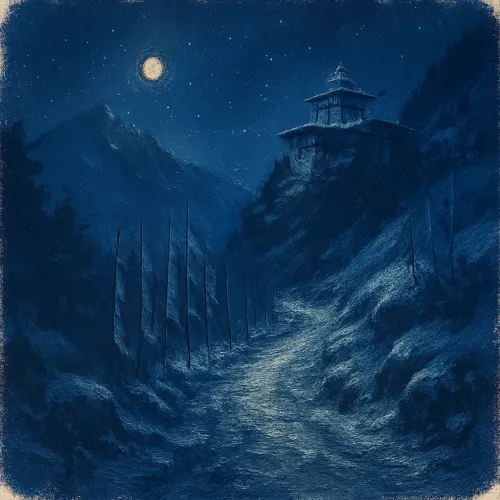
Chapter Sixteen: The Path of Silence
Snow fell in London the morning before Christmas. It was soft, quiet snow — the kind that dusted the railings, blurred the rooftops, and turned the narrow streets into something hushed and gentle. Inside the London Chapter, garlands of pine and gold ribbon framed the halls, and a tall tree stood in the atrium, its ornaments reflecting the amber light of the fire.
The wounds and storms of that long night seemed, for a time, to fade beneath the glow of the season. Even the air inside the house felt different — warmer, lighter.
Elias knew the stillness wouldn’t last. But for now, he let himself believe in it. He folded the darker thoughts away, tucked them behind the scent of pine and the warmth of firelight, and let the moment hold him.
Kiran was home, and his presence grounded the lingering unease. He had stayed close after the rescue; though the tunnels still haunted them, the days that followed filled with small moments of peace: laughter at the breakfast table, long evenings by the fire, the clinking of glasses as snow whispered against the windows.
When Christmas morning came, they gathered in the drawing room. A faint scent of cedar hung in the air. The fire was bright, scattering light over presents.
Elias gave his gifts one by one — the ones he'd chosen during their quiet December in London. There was a flurry of paper and ribbon, followed by the soft, satisfied murmurs of friends who appreciated the thought behind each gift.
When it was Kiran’s turn to give, he brought out small wooden boxes, each carved and lacquered by hand. Inside were simple, beautiful things — each perfectly chosen. For Julian, a tuning fork set in polished stone. For Reina, a pendant of carved jade. For Naomi, a slender quill of blackened silver, its tip etched with runes that shimmered faintly.
When he reached Elias, Kiran placed a small parcel in his palm. “This one,” he said, “I made it before you were born, though perhaps it was meant for you all along.”
Inside lay a pendant — a circular piece of obsidian, no larger than a coin. It was framed by a burnished silver band, delicately sculpted to form the sweeping, inverted shape of two closed wings. The stone was so dark it seemed to swallow light, yet when he tilted it, faint reflections stirred deep within — like stars glimpsed through water.
Elias's breath hitched. He didn't touch the obsidian; he only traced the cool, hard line of the sculpted silver wings with his thumb It wasn't just metal; it was frozen sorrow and skill, rendered as art.
He tucked the small parcel into the inner pocket of his coat. "It is really precious to me; I promise I'll carry it with the honor it deserves."
New Year’s Eve came and went in a wash of light and sound. They stood together on the upper terrace as fireworks bloomed above the Thames, painting the night in bursts of emerald and sapphire; An image Elias would never forget.
Then, with the first week of January, came their departure.
The descent into Paro came through clouds that glowed like frosted glass. The valley opened beneath them—terraced fields dusted with snow, ribbons of rivers threading through cedar-covered hills, and the sharp line of the mountains beyond, rising pale against a blinding sky.
When Elias stepped out, the cold hit him like a blade — sharp, pure, startling. He could smell pine and smoke, the faint tang of incense drifting from the monasteries above.
Kiran led the way through customs with practiced ease; the Order’s clearances smoothed their passage. Outside, two familiar faces waited near the edge of the runway—Marcus, tall and broad-shouldered as ever, his scarf pulled tight against the wind, and Valerie beside him, her dark short hair tied back, flight jacket zipped high. Behind them stood two vehicles, their engines idling softly in the thin mountain air.
There were embraces, laughter, a sense of reunion that felt overdue.
“Bhutan suits you already,” Marcus said, clapping Elias on the shoulder.
“Feels like the air’s trying to kill me,” Elias replied.
Marcus grinned. “Then you’re halfway to enlightenment.”
Valerie stepped forward, her gloved hands resting on her hips. “We’ve got everything ready. The weather’s holding, so we should move before the clouds close in again.”
They climbed into the waiting cars. The narrow road wound out of the valley, tracing the river’s edge before rising into the pine forests. Prayer flags fluttered on high ridges, their colors faded by wind and sun. Every turn opened a new sweep of mountains, white peaks piercing the endless blue.
Elias sat by the window, watching the valley fall away. The world outside felt still, untouched by time.
They stopped at a small stone structure perched above the tree line — an old chorten, half-collapsed, surrounded by weathered prayer wheels that spun lazily in the wind. A helicopter waited there, its blades still, the sun glinting off its smooth frame. The air was sharp and thin, carrying the faint scent of resin and snow.
Elias already knew what came next. Kiran had told him back in London—his path to the Inner Sanctuary would not be the same as theirs. The Order required a solitary pilgrimage: three days through the high passes on foot, a ritual of endurance and silence meant to prepare the initiate for what awaited beyond.
A single figure stood next to the chorten, his robes were the color of clay, his eyes pale and bright as glacier water. When he bowed to Kiran, the movement was slow, deliberate.
Kiran turned to Elias, placing a hand on his shoulder. "This is Tsering," he said, the respect clear in his voice. "He is your guide to the Sanctuary, and for the next three days, he is your only companion."
Tsering’s English was soft but precise. “Three days,” he said. “You walk, you listen, you leave everything behind. The mountain takes nothing it doesn’t return.”
Elias nodded.
They stepped aside, and Tsering motioned toward a simple wooden chest near the chorten. “Everything that is not yourself, you leave here.”
While the others unloaded their packs, he opened the small wooden chest prepared for him. Then, one by one, he removed the remnants of his life. His two rings — cold between his fingers. The pendant Kiran had given him, still glinting faintly in the sun, and the few small gifts exchanged at Christmas. One by one, he placed them inside.
When he looked up, Naomi was standing beside him, her breath clouding in the cold air. “I’ll keep them safe,” she said quietly, taking the box before he could protest.
He hesitated, then smiled. “Thank you.”
When he finished, Tsering handed him a roughspun robe and a pair of sturdy boots. “Now,” he said, “you belong to the path.”
Kiran stood a few paces away, his expression unreadable but warm. “You’ll be met at the Sanctuary gates. Remember — this is not a trial to pass, but a door to open. Take your time.”
Elias nodded once, unable to find words.
Valerie called out, her voice sharp against the wind. “We should go. The weather can turn quick this time of year.”
Marcus moved toward the helicopter, hauling the last of the cases into the hold. Naomi raised a hand in farewell, her smile faint but steady. He could see something like pride — and worry — flicker in her eyes.
Naomi, Reina, Julian, and Kiran climbed aboard. Valerie slipped into the pilot's seat, and Marcus sat beside her. They both waved, and the cabin door slid shut with a solid thunk.
With a low groan, the rotor blades began to turn, slow at first, then faster, throwing snow and dust into the air. The wind surged, carrying the smell of pine and fuel, the roar echoing through the valley until the helicopter lifted and faded into distance.
A deep, profound silence fell upon the valley, broken only by the lazy click of the prayer wheels as they turned in the light, sharp breeze.
Tsering poured a small measure of herbal tea into a wooden cup and handed it to him. “Drink. For clarity.”
It was bitter, earthy, tinged with something like smoke. It left a warmth in his chest that spread slowly outward.
The wind shifted. Prayer flags fluttered, their faded colors snapping against the sky.
“Are you ready?” the monk asked.
Elias looked once more at the road behind — the life he had carried this far. Then he turned toward the mountains, where the trail disappeared into the trees.
“I am,” he said.
Tsering bowed slightly. “Then walk.”
And so he did.
The first sound was the crunch of frost beneath his boots, and then only the wind — low, steady, unending. Ahead, the path wound upward through pines heavy with snow, vanishing into the white silence of the high country.
He didn’t look back.
The path began gently, a narrow trail curving beneath towering pines. Their trunks rose straight and dark against the snow, and the air smelled faintly of resin and cold stone. The only movement came from prayer flags strung between branches, their edges tattered from years of wind. They fluttered weakly, the prayers written on them fading into ghostly threads.
Tsering walked a few paces ahead, silent except for the soft crunch of his boots. His pace was steady, neither fast nor slow — as if the mountain itself had set the rhythm.
They climbed for hours, sometimes through forest, sometimes across open ridges where the wind howled and the snow swirled like dust. The light shifted slowly as the sun moved west, spilling long shadows across the trail.
By late afternoon, Elias’s breath came hard. His shoulders ached, his hands were numb, and his lungs burned with the thin air. But beneath the exhaustion, there was something else — a strange quiet spreading through him, as though the mountain were stripping away thought one layer at a time.
When they reached the first camp, the forest had thinned to bare trees glazed with frost. The camp itself was little more than a stone shelter tucked beneath an overhang — half-collapsed, blackened from old fires.
Tsering set down his pack and gathered wood. Elias helped without words. The motion felt grounding — collecting branches, stacking them carefully, coaxing a small flame to life.
When the fire caught, its warmth felt almost unreal. Elias sat near it, staring at the flicker of orange light against the stone.
Tsering poured tea from a small kettle, the steam curling into the cold air. “The first night,” he said softly. “You will see what you carry.”
Elias frowned. “See?”
The monk’s smile was faint. “The mountain always shows us what still clings to us.”
They ate little — a handful of dried grain softened in tea — and when darkness fell, the stars came alive. The sky stretched immense and clear above the ridge, every constellation sharp against the black.
Elias lay back on the cold ground, the fire dimming beside him, and looked upward. The stars reminded him of the nights he had spent as a boy on the roof of his childhood home, before everything had ended — before loss had hollowed his world.
He saw, too, another night — long ago and yet not long at all. A wide northern sky above a frozen lake. Sigrid beside him, her breath a soft cloud in the cold. She had laughed then, pointing at the constellations. You think too much, Rurik. Just look.
The name, like a whisper from a dream, stirred in him — Rurik. The man he had once been.
Elias closed his eyes. Behind his lids, the stars burned brighter, shifting, forming faces. His parents, faint but smiling — his mother’s hair caught by the light of a candle, his father’s rough hands guiding his as he learned to write his name. Then Clara, her voice soft and bright. His brothers in arms, faces half-lost in dust and fire. And finally Sigrid again, her eyes like stormlight on water.
He felt each memory as if it had weight — not sharp pain, but a deep, aching fullness.
When dawn came, he was still awake, though the ache had softened into something quieter — not absence, but acceptance.
The second day began with frost in his beard and a wind sharp enough to sting his face. They broke camp early. The path climbed steeply, zigzagging between cliffs where the snow had turned to ice.
At midday they reached a narrow ridge overlooking a valley of clouds. The world below was hidden, and only the peaks pierced through, white and silent as ancient teeth.
They stopped briefly. Tsering handed him another cup of the herbal tea, its warmth spreading through his hands. “Today,” the monk said, “you meet the mountain.”
Elias managed a smile. “And yesterday wasn’t?”
“Yesterday you met yourself.”
The climb grew harder. The air thinned, and every breath felt like pulling glass. The wind no longer whispered but roared, pushing at him as if to turn him back. His legs burned, and once, when he slipped on the ice, Tsering caught his arm without effort, steady as a rooted tree.
They crossed a frozen stream, its surface blue beneath a thin crust of snow. The sound of their steps echoed hollow in the silence.
By mid-afternoon, the trail opened onto a barren plateau — a place of rock and snow, no trees, no sound but the wind. Far ahead, the pass rose — a saddle between two peaks where clouds dragged like torn cloth.
They reached it as the sun began to fall.
It was called the Whispering Threshold, though Elias could see no marker, no shrine — only a ring of stones half-buried in snow. The wind screamed through the gap, carrying voices that might have been the mountain itself.
Tsering motioned for him to kneel. “Here, you leave what remains.”
Elias sank to his knees, feeling the cold through his robe. He closed his eyes. The mountain’s breath pressed against him.
At first there was only the sound of wind and blood in his ears. Then — faintly, like ripples under ice — came whispers.
Faces again. But now they weren’t from this life.
A woman standing in desert light, her hair braided with gold. A child running through stone streets. A man on horseback, his armor dark with dust. So many faces, so many names he could not grasp — all flickering behind his eyes like lanterns in a storm.
He gasped, the visions rushing over him. A lifetime, then another, then more. Joy and loss, birth and death, the endless turning of a wheel that had never stopped.
When he opened his eyes, the world was different — clearer, sharper. The sun had dropped below the ridge, painting the snow in copper light.
Tsering watched him quietly. “What did you see?”
“Too much,” Elias said hoarsely.
The monk nodded. “Then you saw truth.”
They made camp on the far side of the pass, sheltered in a hollow where the wind softened. The night was colder than the first, the stars nearer, the silence so complete that even the crack of the fire felt like a trespass.
Tsering gave him another cup of the bitter tea. “Tonight you rest between what was and what will be.”
Elias drank. The warmth spread slowly through him, but with it came a heaviness, a drifting calm. His thoughts scattered. He lay down, watching the fire fade, and in that in-between space, sleep and waking blurred.
He dreamed.
He was standing on a shore beneath a black sky. Waves broke soundlessly on the sand. A figure approached — cloaked in light and shadow both, its voice a deep thrumming like the wind itself.
“You keep walking in circles,” the thrumming echoed. “But this path ends only when you stop running from what you are.”
“Who are you?” he asked, though he knew.
The one you were meant to remember.
He reached for it, but the figure was suddenly unwoven, a rope of shadow and light unraveling into a gale. The deep thrumming voice became a shriek of wind, and he was falling—through stars, through time, through everything he had ever been.
He woke just before dawn, the fire reduced to a bed of glowing coals. Tsering was already awake, sitting cross-legged, eyes closed in meditation.
“Dreams,” the monk said softly, without opening his eyes, “are only the mountain speaking in your own voice.”
Elias said nothing. He looked eastward. The horizon was turning pale gold.
The third day dawned clear and windless. The sky was so blue it hurt to look at.
They began their descent into a narrow valley hemmed by cliffs. The snow thinned, replaced by patches of dry grass and stone. Streams ran beneath sheets of ice, their sound a faint, steady murmur.
By midday, the air grew warmer. Prayer flags began to appear again, faded and torn but still whispering in the breeze.
Tsering spoke little. His silence seemed deliberate, as if words would break whatever sacred rhythm carried them forward.
When they rounded a bend near a stand of junipers, Elias saw it — at first only a shape in the haze. Then, as they drew closer, the mist lifted.
The Inner Sanctuary revealed itself slowly, as if the mountain were unveiling it by degrees.
It was built into a sheer cliff rising above the valley, its white walls gleaming against the dark rock. Terraces and prayer halls clung to the face of the mountain like wings, and high above, golden roofs caught the sun. Waterfalls poured from hidden springs, turning to mist before they reached the ground.
Elias stopped walking. His breath caught.
Even after everything — the tunnels, the demons, the dreams — this felt different. Holy. Real.
Tsering stood beside him, his eyes bright with reflected light. “Few come this way. Fewer still reach the gate.”
They descended the final slope in silence. The air grew thick with the scent of incense and juniper smoke. The ground underfoot was paved with smooth stones, worn by centuries of feet.
At the base of the cliff, a long stairway rose, carved directly into the rock — narrow, steep, bordered by prayer wheels that spun in the wind.
At the foot of the stairs stood a small stone basin filled with clear water. Tsering motioned for him to stop.
“This is where I leave you,” he said. “From here, you go alone.”
Elias looked at the stairway. The sound of the wind had changed — deeper now, almost like a heartbeat echoing through stone.
Tsering took the wooden cup and dipped it carefully into the basin, drawing up a measure of the clear, cold water. "For the final breath before silence," he said, handing the cup to Elias.
Elias drank. The water was ice-cold at first, but a strange, fierce warmth spread through him like fire and light together.
“Will I see you again?” he asked.
The monk smiled. “You will not need to.”
For a moment, neither spoke. Then Elias reached out and clasped the man’s hand. It was dry and strong, like carved wood.
“Thank you,” he said.
Tsering bowed. “Walk with what you are.”
Elias turned toward the stairs. The wind rose, lifting the ends of his robe.
Step by step, he began to climb.
The air grew thinner, sharper. The stairs narrowed until only one person could pass at a time. On either side, the drop fell sheer into mist. Above, the sanctuary gleamed in full light, so bright it seemed carved from the sky itself.
By the time he reached the final platform, his legs trembled and his breath came ragged. But he didn’t stop.
A wide wooden gate stood before him, set into the rock—its surface carved with a single emblem. He recognized it at once: the seven-pointed star entwined with a feathered ring, the same mark that crowned the London Chapter’s gates.
In the fading sun, the carving caught the light, sharp and unmistakable.
He placed a hand against it. The wood was warm, worn smooth by centuries of touch, as though the mountain itself remembered every pilgrim who had come before.
Behind him, the valley spread in gold and shadow, clouds drifting through the peaks. He thought of Naomi’s laughter, Julian’s reckless grin, Reina’s quiet courage, Kiran’s steady eyes— all the lives now woven into his own. He thought of Sigrid, of Clara, of his parents, of every soul whose memory lived in him.
The wind stirred, carrying the low sound of distant bells.
He took one final breath, steady and clear, and whispered to the silence:
“I’m ready.”
Beside the gate hung a frayed rope. Elias grasped it and pulled. A bell tolled, deep and resonant, its echo rolling across the cliffs.
Moments later, two monks appeared. They studied him in silence, then pushed the heavy wooden doors inward. Without a word, they granted him passage.