Chapter Thirteen: The London Chapter
The descent into London came through a wall of fog.
Through the oval window, Elias saw faint streaks of amber cutting through grey—a city caught between the brief daylight and the encroaching long evening. The jet tilted slightly, engines humming as it broke through the cloud cover. Below stretched the sprawl of London in late-autumn gloom: wet rooftops gleaming like slate, red buses gliding through damp streets, headlights blurring into ribbons along the motorways. The bare trees of the parks looked skeletal against the rapidly fading sky.
He felt the tremor as the wheels touched the runway. A muted thud, then the steady deceleration. The clock on the cabin display read 16:17 GMT.
He pressed his palm against the cool pane. He’d crossed oceans before, but never with a name that wasn’t his.
Reina leaned across the aisle. “Remember your name,” she murmured. “Adam Novo. Born in Lisbon, 1986. Cyber-security consultant. Keep it simple—no embellishments.”
Elias nodded. The passport in his jacket felt deceptively ordinary—creased edges and faint smudges where fingers had held it hundreds of times. Reina's work had gone beyond printing; she’d built a history.
“Adam Novo,” he repeated quietly. “Got it.”
Julian, half-lounging beside him, offered a crooked smile. “Try not to look like you’ve been shot at on one continent and smuggled into another.”
Elias arched a brow. “That obvious?”
“Only if they ask why you’re guarding your arm like it’s the Crown Jewels.”
The jet slowed to a crawl near a discreet terminal—frosted glass, a muted logo—Farnborough Airport. Outside, ground crew in reflective vests materialized through the drizzle, their movements swift and precise. Reina unbuckled first.
"Look the part, Adam," she said. "We need to project calm—we’re professionals now, not runaways."
The cabin door opened with a soft hiss, and a gust of cold air swept in, carrying the metallic tang of jet fuel and rain.
From his window seat, Elias saw them waiting beyond the marked safety line: a small reception band of figures standing beneath the wing. Naomi, Marcus, and Valerie had already disembarked and were meeting them halfway.
One figure dominated the scene.
Tall. Broad-shouldered. Dark hair slicked back from a face that belonged to command. The cut of his coat was military, but the posture—unmoving, perfectly centered—spoke of something older than discipline.
He radiated authority the way other men breathed.
Naomi reached him first. They spoke briefly, their voices carrying only a faint, unintelligible hum across the tarmac, but something in her stance shifted—shoulders tense, chin slightly lifted.
Julian followed Elias’s gaze. “That,” he said under his breath, “is Commander Lucien Ardea. Member of the Council, and the Elder’s right hand.”
“Sounds important,” Elias murmured.
Julian’s smile thinned. “Important doesn’t begin to cover it. He’s the one who decides which wars are worth fighting—and who’s allowed to survive them.”
Elias frowned. “And he’s here for us?”
“No,” Julian said. “He’s here for that.”
Outside, Lucien’s attention moved to the armored crate Marcus and Valerie were unloading—the artifact’s container. His soldiers, three of them, spread out in a subtle perimeter, movements crisp and wordless. They wore no insignia, but their stillness carried a weight that set them apart.
Lucien spoke again, sharper this time. Naomi’s expression hardened; her reply was defiant.
Reina’s voice cut through. “Julian, go meet the Ground Agent. Make sure our bags clear without issue. Elias, stay put until Border Force boards.”
He watched through the rain-streaked glass as the exchange on the apron grew taut. Lucien’s tone was low but unyielding. Naomi’s jaw set. Their silhouettes angled toward each other like two forces that had collided too often.
Then Naomi turned away, refusing something he said. Lucien’s posture stiffened.
Two officers in plain suits boarded the aircraft, their professionalism brisk and courteous. Reina handed them a folder—General Aviation Report, pre-filed and immaculate.
“Good afternoon,” the male officer said. “Welcome to the United Kingdom. Purpose of visit?”
“Business,” Reina replied smoothly.
He flipped through the passports. When his eyes reached Elias’s photo, he gave a polite nod. “Mr. Novo, how long will you be staying?”
“A few days,” Elias said evenly.
The officer stamped the document, satisfied. “Enjoy your time in London.”
Minutes later, the formalities were complete—the luggage check was swift, and there were no unnecessary questions.
Reina waited until they’d gone. “That’s the easy part done.”
The metal stairs were slick with rain. The air bit cold against Elias’s face as he stepped down. The runway shimmered in reflected light, puddles doubling every movement.
Lucien turned as they approached. His gaze swept over Elias—one measured glance, swift and dismissive—before settling on Naomi again.
“You’re coming with me,” Lucien said. His voice carried quiet power, the kind that didn’t need volume to command. “The Elder expects you in Bhutan. The artifact travels under direct supervision.”
Naomi met his stare without flinching. “Marcus and Valerie will handle that. I’m staying here.”
Lucien’s tone cooled. “That wasn’t a request.”
“I know.”
Rain gathered in Lucien’s hair, running down the collar of his coat. “You’ve disobeyed before, Naomi. Don’t test me again.”
“If I hadn’t,” she said, “you’d have nothing to deliver.”
Elias caught fragments of the exchange through the wind—the clipped rhythm of words between people who’d known each other too long.
Lucien stepped closer. “Don’t tell me this is about him.” His eyes flicked toward Elias, sharp as a blade’s edge. “A human, Naomi?”
“He’s more than his current shadow,” she said quietly.
Lucien’s expression was controlled, but the air around him seemed to tighten, the drizzle turning to fine mist. “You’re risking everything for sentiment.”
Naomi’s reply was steady. “For purpose.”
The silence that followed was brittle. Finally, Lucien exhaled, a sound halfway between restraint and warning. “Very well. His fate—and your defiance—are now tied. See that it doesn’t undo you.”
He turned to Marcus and Valerie. “You’ll come with me. Now.”
They exchanged brief nods with Naomi—unspoken farewells—and followed as Lucien’s soldiers lifted the crate with effortless precision. Within minutes, the sedan's taillights vanished into the damp air, swallowed by the greying horizon.
Naomi stood motionless, rain beading in her hair.
Elias approached cautiously. “Friend of yours?”
“Something like that,” she murmured.
Julian muttered, “More like a ghost she hasn’t buried.”
Reina gestured toward the waiting Range Rover idling nearby. “We’re clear. Let’s move before the next shift change.”
They climbed in. The doors shut, sealing them inside a cocoon of leather and low heat.
As the car pulled away from the terminal, Elias looked back once more. The runway faded into fine gloom, a smear of light and shadow dissolving behind them.
Reina glanced at him through the rear-view mirror. “Welcome to London, Adam Novo.”
The rain followed them out of the airport.
It came softly—fine, silver threads drifting down through the halogen glow of the tarmac lights, catching on the Range Rover’s windshield before the wipers swept them aside in rhythmic arcs. By the time they merged onto the highway toward the city, the light was already fading, the November sky bruising to violet at the edges.
Inside the car, the air was warm and faintly scented with leather and ozone. The driver—quiet, middle-aged, with the unshakable patience of someone used to London traffic—handled the wheel with smooth precision.
Reina sat in the front passenger seat, her tablet in hand, displaying data Elias couldn't decipher. Julian and Elias shared the back, Naomi between them, her gaze resting absently on the window.
They passed clusters of traffic edging their way toward the city—rows of red taillights pulsing like glowing coals in the haze. The motorway stretched ahead in ribbons of wet asphalt, the surrounding fields lost in the pale dampness.
For a while, no one spoke. The city’s approach measured itself in the hiss of tires and rain.
“We’ll stay in London for a while,” Naomi said quietly, eyes on the passing wet glass. “Bhutan’s borders are sacred ground to the Order. No outsider enters without clearance—and you, Elias, are still just a name on a list.”
Elias glanced at her. “So I’m… an outsider?”
“For now,” Naomi said. “They need to process your records and establish a paper trail—something fully verifiable. That takes time.”
“How long will that take?”
“Weeks. Maybe more. Bhutan’s process is slow even for us—and it’s nearly December.”
Julian smirked faintly. “The Council doesn’t like surprises, and you, mate, are one hell of a surprise.”
Elias leaned back, his reflection ghosting faintly in the window. Outside, the sky deepened to slate. Early Christmas lights were already strung—white and gold threads stretched over pubs and stores like constellations caught in rain.
“ETA is 18:05,” Reina said, without looking up from her tablet.
Outside, the traffic inched forward. Julian sighed. “London never changes.”
Naomi’s gaze stayed on the window. “It hasn’t truly changed in centuries,” she said, almost fondly.
There was a weight in her voice. Elias followed her gaze across the Thames, its dark surface rippling with the reflected lights of a city forever caught between the past and present.
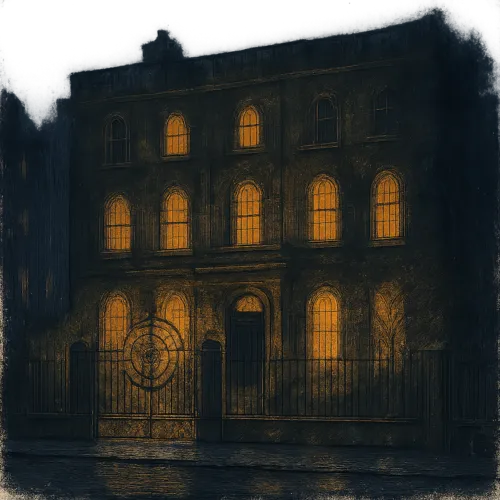
As they drove deeper into the city, the streets grew narrower, lined with tall Victorian townhouses of brick and stone. Their façades glowed with lamplight, windows framed by ivy and wrought-iron balconies.
The driver slowed as they turned into a wide square, where the trees still held a few stubborn leaves, copper against the gloom. Christmas lights had begun to appear along the branches—simple strands of white, soft as candlelight.
“This is it,” Reina said.
Ahead stood the London Chapter.
At first glance, it could have been a museum or an embassy—a grand Georgian mansion stretching three stories high, its frontage a tapestry of sandstone and darkened ivy. The building’s windows were tall and arched, framed by intricate moldings, and its iron gates bore a complex design worked subtly into their pattern: a seven-pointed star entwined with a feathered ring.
As the Range Rover pulled up to the entrance, the heavy oak doors opened before they could knock. Two attendants in tailored dark suits stepped out, umbrellas already unfurled against the drizzle.
“Welcome home,” one of them said, his accent crisp, practiced.
As they stepped inside, warmth enveloped them like a sigh of relief. The entry hall was vast—its floor polished to a mirror sheen, its ceiling soaring with carved panels of oak and plaster. A chandelier hung at the center, all crystal and gold, refracting light into quiet fire. The air smelled faintly of rain, old books, and something citrus, like bergamot and polished wood.
Elias paused just inside the threshold, caught between awe and disbelief. The place didn’t feel like a Chapter House; It felt like history had taken root here and refused to let go.
A man descended the marble staircase at the far end. Tall, elegant in movement, with dark hair silvered slightly at the temples. His tailored waistcoat and immaculate posture made him seem ageless.
“Ah,” he said warmly, his voice carrying that distinctive London lilt—smooth, musical, the vowels rounded by years of eloquence. “You made excellent time. Welcome inside.”
Reina stepped forward first. “Kiran.”
Kiran smiled, genuine and luminous. “Reina. It’s good to see you again.” His handshake was firm but welcoming. He turned his smile to the others. “Naomi, you look radiant as ever, and Julian—still watching the world from the edges, I see.” He turned to Elias, eyes bright with curiosity. “And this must be the newcomer I’ve heard so little—and yet so much—about.”
Naomi stepped forward, resting a confident hand lightly on Elias's shoulder—a subtle signal of reassurance.
“Kiran,” she said, her voice clear. “May I introduce Elias Shirazi.”
Kiran’s smile deepened in welcome. He stepped toward Elias, already offering his hand. “Kiran Varma,” he supplied smoothly. He looked at Elias, drawing out the name as though savoring it. "Elias... welcome to the London Chapter. You’re safe here.”
Elias took his hand, the solid, reassuring pressure instantly grounding. “Thank you, Mr. Varma.”
“Please,” Kiran said, giving his hand a gentle squeeze. “The only person here who calls me Mr. Varma is my accountant. Just Kiran.”
His voice carried a warmth that immediately softened the room. Even Julian’s guarded expression eased slightly.
Kiran’s eyes gleamed with subtle amusement. “I’m afraid you’ll have to forgive the grandeur. This house predates most of our records. It once belonged to a collector of antiquities—a man with too much money and not enough caution. The Order acquired it in the early nineteenth century.”
He gestured for them to follow as he spoke, his tone lilting with quiet pride. “It’s one of the few Chapters that hasn’t been modernized beyond recognition. The Elder likes to say it still breathes with the rhythm of the old world.”
They passed through the main hall and turned left into a long corridor lined with portraits—men and women in garments from every century, their eyes rendered with uncanny realism. Beneath each frame was a name—some historical, some utterly obscure to Elias.
Halfway down, an open archway to the right revealed the library, whose walls rose two full stories, balconies lined with carved balustrades. Shelves upon shelves of books—parchment, leather, vellum—stretched into shadow. Lamps glowed between the shelves, casting golden circles over the polished floor.
Elias slowed, momentarily forgetting the ache in his arm. The air hummed faintly in the library, as though every object there remembered the hands that had touched it.
Kiran noticed his pause and smiled. “The Library of Saint Alban,” he said softly. “A reconstruction, of course—the original burned in 1666. We rebuilt it to its last surviving plan.”
Naomi’s lips curved faintly. “Can a reconstruction ever capture the soul of what it replaces?”
“Perhaps not,” Kiran said, his gaze trailing over the shelves. “But it can hold a better one. We don’t just rebuild what it was—we shape what it can be.”
He led them on, past the library and through another archway, into a broad landing lit by tall windows. Outside, rain streaked the glass, turning the view of the square into a watercolor blur of trees and passing headlights.
At the end of the landing, Kiran stopped beside a marble bust—its features serene, worn smooth by the hands of time. “This belonged to a Roman artisan who believed beauty was the last defense against decay,” he said, almost absently. “He was right, I think. The Artisans have always believed creation is the one echo that defies the Fall.”
Elias caught Naomi’s glance—subtle but telling. He saw a recognition pass between them, a shared, silent language of names and meanings he couldn't decipher. It only heightened the unsettling sense that Kiran—and this house—operated by rules entirely unknown to him.
A few paces beyond, the landing opened onto a branching stair. Kiran turned to them again. “Rooms have been prepared upstairs. You’ll find everything you need. We dine together at eight.”
Reina inclined her head. “Thank you, Kiran. It’s good to be here again.”
“The pleasure is mine.” He gestured toward one of the attendants. “Mr. Rao will show you to your quarters. Please, make yourselves at home. It’s rare these halls host guests who still have questions left to ask.”
There was something cryptic in that last line, but his smile turned it into charm.
The attendant—slender, quiet, with the unhurried composure of old service—led them up the wide staircase. The second floor opened onto another long hallway carpeted in deep blue, its walls lined with sconces that flickered like candlelight.
Naomi’s room was first. She paused by the door, looking briefly at Elias. “I’ll see you at dinner,” she said softly. “Try to rest, Elias.”
Julian’s was next, and Reina’s further down. The attendant stopped finally at a carved oak door halfway along the hall.
“Your room, Mr. Shirazi.” He opened it with a quiet click and stepped aside.
Elias entered.
The first thing that struck him was the light, which spilled from a massive chandelier. The room was huge, high-ceilinged, its walls the color of aged parchment. The windows stretched nearly floor to ceiling, framed by heavy drapes of deep green velvet. Beyond the steamed glass the view was indistinct, defined only by the glow of London's gaslamps.
Inside, the room was timeless—elegance without ostentation. A wide four-poster bed draped in crisp linen stood against one wall, its carved posts burnished by decades. A writing desk occupied the space near the window, beside a low bookshelf filled with volumes that smelled faintly of cedar and ink. An oil painting hung above the fireplace: a landscape of stark relief and ruins, caught between dusk and dawn.
A tray rested on the table—tea, still steaming, and a folded note. The handwriting was neat and formal, clearly belonging to the Master of the house. It read:
Rest well, Elias. The city is quieter when it rains.
Elias smiled faintly. He removed his jacket, setting it over the armchair, and picked up the teacup, the china warmth soaking into his cold fingers. He crossed to the window, and wiped a clean arc with his free hand. The glass was cold under his fingers.
The rain had slowed to a mist. The city beyond looked like a dream—old and alive, a thousand lives moving beneath a single grey sky. The view looked directly out over the large square he now knew to be Russell Square, the name easily legible on a corner street sign lit by the warm glow of a gaslamp.
Flickering gaslight cast golden halos across wet pavement among the trees below. People hurried along the sidewalks, umbrellas tilted, their reflections trailing in puddles. In the distance, the faint chime of a church bell marked six-thirty.
He watched the traffic crawl past, the reflections of lights shimmering in the wet streets, and felt the strange weight of being somewhere both entirely new and achingly familiar.
He sank into the armchair, exhaustion settling into his bones.
Behind him, the fire was crackling softly in the hearth, filling the air with a quiet, suffusing warmth. He took a sip of tea, the moment of peace made heavier by his fatigue.
Downstairs, somewhere beyond the walls, he could hear faint echoes of life—the murmur of voices, the low thread of a piano in another room.
His thoughts drifted to the library—the smell of old parchment, and the vast, quiet gloom. Clara would have loved it, he thought. She always loved places with stories. Libraries, ruins, archives. She used to trace her fingers over old spines like they were relics, whispering lines from books as if reading them could summon the ghosts of their authors.
A smile flickered across his lips, brief and bright, before souring into the familiar taste of loss.
He let the feeling settle. Then his mind circled back, stubbornly, to the chamber downstairs. There was something about that place—a quiet pull that hadn’t let go of him since he first saw it. It wasn't curiosity. It was deeper.
He stood, put the teacup on the table, and stretched his sore arm. The warmth of the fire clung to his skin as he crossed the room and opened the door. The hallway was dim, lit only by sconces and the occasional flicker of lamplight through glass. The building seemed quieter now, hushed with that particular stillness old houses carried after dark; the deep silence of forgotten centuries.
He moved soundlessly down the corridor, his footsteps absorbed by the thick carpet. A faint, golden light spilled from the library’s archway, cutting a luminous stripe across the marble floor. He hesitated only a second before stepping through.
The sight struck him like a fresh breath.
The Library of Saint Alban was even more beautiful now than it had been earlier. The lamps were turned low, burning amber and soft, casting trembling shadows through the air like candle flame under water. The scent of age filled the space—paper, dust, ink, and a whisper of wax polish. Every sound in the room seemed amplified: the low sigh of the building settling, the rain tapping faintly at the windowpanes, the beat of his own pulse in his ears.
Two stories of shelves rose around him in a perfect circle, climbing toward the domed ceiling, which was painted with constellations—faded but still visible under the flickering light. A narrow wrought-iron staircase spiraled up to the balcony above.
Elias moved slowly between the shelves, his gaze tracing titles too faded to read, the lettering worn smooth and faint by ages of touch. Most were in Latin, Old English, Old Norse, Greek—languages he only half understood. Some were bound in leather, others in materials that looked like treated bark or thin metal, etched with runes that shimmered faintly when his eyes lingered.
As he ventured further, a soft whispering brushed his ears—a tremor in the air too faint to name. He turned, expecting to find someone behind him. No one was there.
Then he saw it. Across the floor stood a glass case, tall and solemn, its edges gilded, the interior lit by a single warm light. Inside, several artifacts lay displayed on velvet: a bronze disc, a length of woven cord turned almost to dust, a fragment of carved ivory. But his gaze went straight to the smallest object there—a silver ring.
It stopped him where he was. He knew it. The style was unmistakable, taking him back to the striking clarity of his dream—another life, another name. Sigrid’s face rose unbidden: fair hair braided with amber, blue eyes bright with love. He saw her hand pressing the ring into his.
His throat tightened.
The whisper returned, clearer now, curling through his mind like smoke: Rurik.
He took a step closer, then another. The air around the display seemed denser, almost charged, humming softly against his skin. His reflection in the glass looked different somehow—eyes darker, sharper.
He didn’t know how long he stood there, lost in it.
“I know that look,” a voice said gently behind him.
Elias turned, startled.
Kiran was standing a few paces away, his hands clasped loosely behind his back, expression unreadable but kind. Elias hadn't heard him enter, nor could he guess how long Kiran had been there, silent as the shadows.
“You recognize something there, don’t you?”
Elias swallowed, his gaze locked on the silver ring. His voice came out rough, a strained whisper. “That ring. Someone gave it to me. A woman I loved.”
Kiran stepped closer, his gaze softening. “It is a remarkable piece,” he said. “I can tell it was created by one of us—an Artisan, like me. It carries history in every thread of silver.” He smiled faintly. “I acquired it a few years ago at a private auction in London. It was found during an excavation on the East Shores of England—within the ruins of a burned, ninth-century Viking settlement.”
Elias stared. He smelled the brine and smoke instantly; the world tilted.
Kiran approached the case and, with a slow, deliberate motion, pressed a small mechanism on the side. The glass door slid open with a soft click. The scent of old metal and oil drifted into the air.
He reached inside and lifted the ring carefully between his fingers, holding it as though it might crumble if handled too roughly. The lamplight caught the silver, scattering it into delicate threads of light across the walls.
Elias couldn’t move. The whisper in his mind grew louder, more insistent.
Kiran turned the ring in his palm. “Beautiful craftsmanship,” he murmured. “No seams. No beginning or end. The Artisan who made it believed memory could be bound in metal—that if love and loss were woven finely enough, they would survive eternity.”
He looked up at Elias. “I can feel it calling you.”
Elias’s breath caught. “I… feel it too.”
“Take it, then,” Kiran said, extending his hand. “It has waited long enough.”
Elias hesitated, his hand trembling with the effort to resist. “If I take it… I don’t think I could give it up again.”
“Then don’t,” Kiran said softly, stepping closer. “Take it. It has found its true owner at last.”
Elias opened his palm. The metal was cool when Kiran placed it there—almost cold enough to sting. The moment it touched his skin, a wave went through him like a current of wind and fire intertwined.
The whispers became voices.
Rurik.
He saw flashes of snow and sea, of fire and blood, of hands clasped together under the northern lights. He saw her—Sigrid—smiling, reaching for him, her lips forming his name. The vision crashed into him with unbearable clarity: the smell of pine smoke, the sound of laughter, the taste of salt on the wind. And then—the arrow. The scream. She staggered, and then fell, the distance between them widening into a gulf.
The memory tore through him like a storm.
Tears slid down his face before he even realized it. For a moment, he wasn’t Elias—he was Rurik, standing in the ruins of his village, holding the woman he loved as the sky burned above them.
And then it was gone.
He was back in the library, shaking, the ring gleaming on his finger. His breath came ragged, shallow. He didn’t even remember putting it on.
A hand settled gently on his shoulder.
Kiran’s voice came softly, close to his ear. “Remembering is always hard. Overwhelming. All those feelings rushing back at once. But it’s beautiful, too—watching a soul remember itself.”
Elias tried to speak, but his throat was dry.
“Come,” Kiran said. “I have something that can help.”
Elias followed without question. His body moved as if in a trance, the ring’s weight pulsing faintly with each heartbeat.
They left the library and entered a smaller room lined with dark wood and faint lamplight. It was a study, filled with maps, scrolls, and glass bottles arrayed on shelves. Kiran poured something from a decanter into a crystal glass and held it out. The liquid glimmered faintly gold, thicker than wine.
“Drink,” he said.
Elias hesitated only a moment before taking it. The taste was sweet—honey, spice, and something like warmth itself. It spread through him almost instantly, dissolving the ache in his chest, the tremor in his hands. His heartbeat steadied. His breath slowed.
“What is it?” he asked quietly.
Kiran smiled. “It's a recipe of mine. A blend of things best left unnamed. Let’s just say it helps the soul to settle after a storm.”
Elias managed a faint, grateful smile. “I think it’s working.”
“Good.” Kiran poured himself a glass and sat opposite him. “So, what did you see?”
Elias stared into the fire, the words catching in his throat before they finally came. “Her name was Sigrid. We lived near the sea, in a small settlement. I was a warrior then—Rurik. I loved her. She… she gave me the ring. Said it was her mother’s, passed through generations.” His voice wavered.
Kiran was listening silently, his expression calm, compassionate.
Elias continued, his gaze still fixed on the flames. “She told me about an ancient order, older than any kingdom. About the Stone Hall—the great stone circle. A place for the chosen to awaken what was buried deep inside. A place for true remembrance.”
Kiran’s eyes widened at the mention of the Stone Hall, a flicker of recognition crossing his face, though Elias did not see it.
“I tried to protect her,” Elias whispered. “But—I failed.”
He rubbed his hands over his face, the ring glinting in the firelight. “It felt like it happened all over again. Like I lost her just now.”
For a long time, neither spoke. Only the crackle of the fire filled the room.
When Elias finally looked up, Kiran’s eyes were bright but grave. “Memory is not bound by time,” he said softly. “When it returns, it does so whole—joy and pain together. That’s the gift and the curse of awakening.”
Elias exhaled shakily. “It doesn’t feel like a gift.”
“It rarely does,” Kiran replied. “But it means you are closer to the truth of yourself. Every life you’ve lived leaves a thread. Today, one of yours was pulled back into the light.”
Kiran studied him a moment longer, then smiled gently. “You look exhausted. Rest now. I’ll tell the others you won’t join us for dinner. They’ll understand.”
“Thank you,” Elias murmured.
“Shall I have something sent up later?”
Elias shook his head, the motion slow, heavy. “I don’t think I could eat.”
Kiran nodded. “Sleep, then. And don’t fear the dreams. Sometimes, they’re the only place the truth can speak.”
Elias rose, the room spinning faintly. He thanked Kiran quietly and made his way back through the hallways, his hand absently brushing the ring on his finger as if to confirm it was real.
By the time he reached his room, the house was silent. The rain outside had stopped. London’s glow pressed faintly through the steamed window, distant and blurred.
He closed the door, kicked off his shoes, and fell onto the bed without undressing. The sheets were cool and soft beneath him.
He lay there, fighting the overwhelming exhaustion brought on by the sudden remembrance of a lifetime. He lifted his hands, and the contrast was immediate: Two rings on his fingers; two tokens of women he had loved deeply. The simple gold band on his left hand felt soft and familiar, but the silver ring on his right hand pulsed with a frigid weight.
As his gaze focused on the silver ring, the memory rushed back—not as a vision, but as brutal, unyielding truth. He heard his own voice, ragged and ancient, swearing the impossible vow as he held Sigrid’s lifeless body: to find the cruel gods, to punish them for all of their crimes, and to shatter this infinite cycle of pain and suffering, so that he could meet her one more time.
This promise was his alone—a burden he could not share, a vow he could not break. He closed his eyes, and exhaustion finally blurred the memories into sleep. But even in the silence, the ring’s cold weight remained on his hand: an ancient debt that had now come due.